




Atopic Eczema Skincare Tips: A Dermatologist’s Guide to Calmer Skin
By Dr Matete Mathobela
Reviewed by Dr Matete Mathobela – Specialist Dermatologist
Founder of MD DermOutlet and MD Cosmeceuticals by Matete Derma
Read more about Dr Matete Mathobela →
Medical Disclaimer
This article is for educational purposes and does not replace individual medical advice. Severe, infected, frequently recurring or poorly controlled eczema should be assessed by a healthcare professional.
Atopic Eczema Skincare Tips for Everyday Care
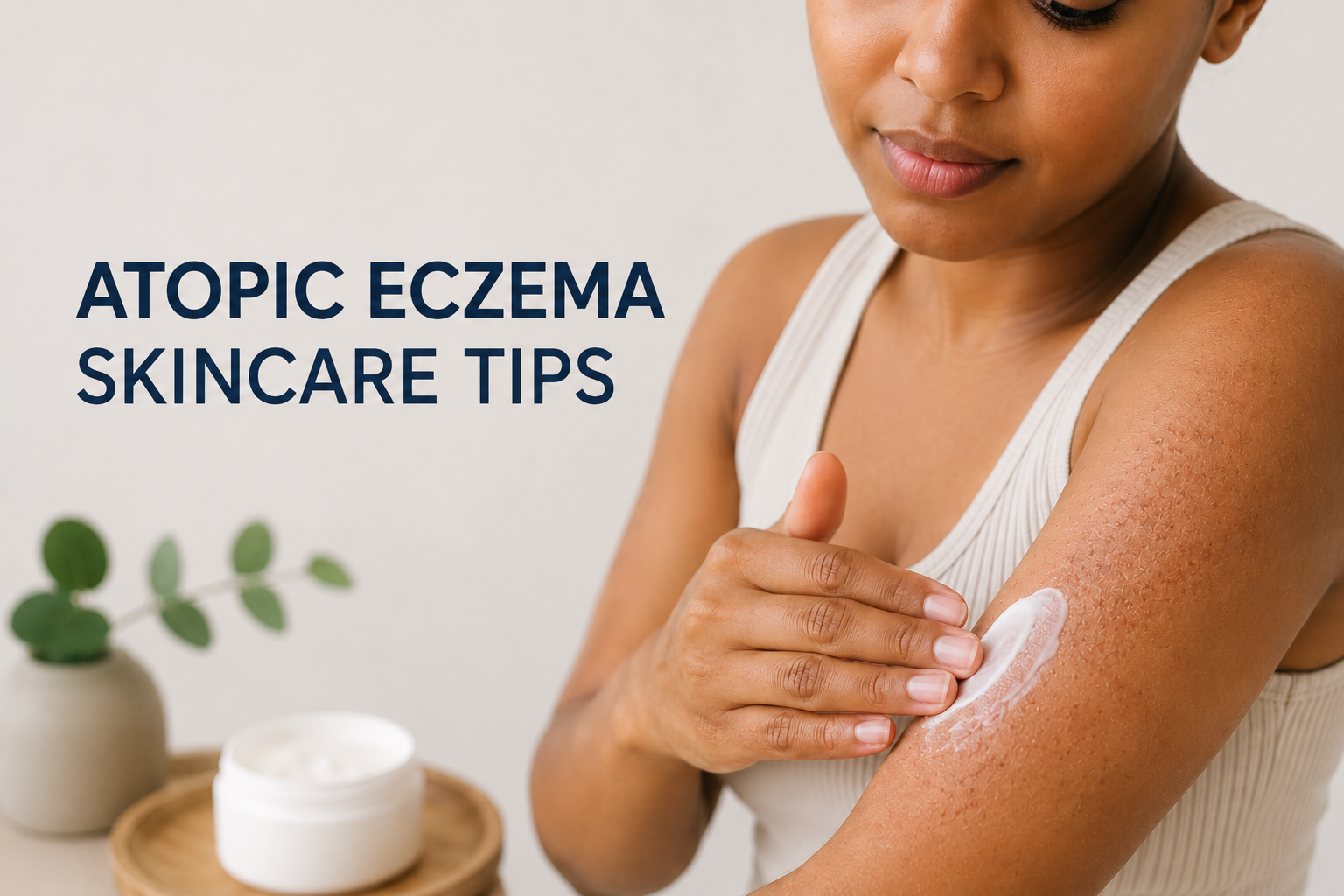
Good atopic eczema skincare tips should focus on one main goal: protecting and supporting the skin barrier.
Atopic skin loses moisture more easily and is more vulnerable to irritation. A consistent routine can help reduce dryness and discomfort, but active eczema may still require medical treatment.
1. When Should You Moisturise After a Bath or Shower?
One of my most important atopic eczema skincare tips is to moisturise within 3 minutes of bathing or showering.
Keep baths and showers short and lukewarm. Afterwards, gently pat the skin dry, leaving it slightly damp, and immediately apply a generous layer of moisturiser. This helps trap water in the skin before it evaporates.
Easy rule: wash gently → pat dry → moisturise within 3 minutes.
2. What Should You Look for in an Eczema Moisturiser?
For eczema-prone skin, I generally prefer a fragrance-free cream or balm over a light lotion, particularly when the skin is very dry.
Look for ingredients such as ceramides, glycerin, petrolatum, mineral oil and colloidal oatmeal, which can provide moisturising, emollient or barrier-supporting benefits.
Specialist-selected ranges such as La Roche-Posay Lipikar, Bioderma Atoderm, Avène XeraCalm A.D, CeraVe, Epi-Max and BioNike Triderm offer different textures for different levels of dryness.
There is no single best eczema moisturiser. The right choice should provide enough moisture while being comfortable enough to use consistently.
3. Still Dry After Moisturising? What Can You Add?
If your skin looks or feels dry again shortly after moisturising, you may need an additional occlusive layer.
Apply your cream or balm first, then add a thin layer of plain petroleum jelly (Vaseline) or an occlusive ointment, such as Aquaphor or a suitable Epi-Max ointment, over very dry areas.
If you dislike the thick, greasy feel of an ointment, an appropriate fragrance-free emollient body or tissue oil can be layered over your moisturiser. However, oils generally do not provide the same degree of occlusion as petrolatum-based ointments and should not replace your main moisturiser.
This is one of those atopic eczema skincare tips that should be personalised—the best texture is one you will actually use consistently.
4. What Should You Wash Eczema-Prone Skin With?
Choose a gentle, fragrance-free, soap-free cleanser rather than harsh soaps or strongly foaming body washes.
For very dry skin, emulsifying ointment can also double as a soap substitute.
An appropriate bath oil or liquid paraffin may be useful for selected very dry skin, although bath additives are optional rather than essential if you already have a good leave-on moisturising routine. Remember that oils can make the bath slippery.
5. What Should You Avoid if You Have Atopic Eczema?
Good atopic eczema skincare tips are also about what you leave out.
Try to avoid fragrance/parfum, essential oils, harsh soaps, physical scrubs, exfoliating brushes and unnecessary acids or irritating actives on actively inflamed eczema.
Choose products labelled “fragrance-free” rather than simply “unscented,” and avoid very hot bath or shower water.
6. When Is Skincare Not Enough for Atopic Eczema?
Moisturisers support the skin barrier, but they do not replace treatment for active eczema inflammation.
If your eczema remains very itchy or inflamed, repeatedly flares, becomes painful, cracked or starts oozing, it should be assessed. Appropriate anti-inflammatory treatment—and sometimes treatment for infection—may be required.
Dermatologist’s Perspective
The atopic eczema skincare tips I give are personalised because not everyone needs the same product or texture.
For some people, a cream or balm is enough. Extremely dry skin may benefit from an ointment layered over moisturiser, while someone who dislikes greasy ointments may prefer an appropriate emollient oil.
The fundamentals remain simple: cleanse gently, moisturise within 3 minutes, avoid unnecessary irritation and treat active eczema appropriately.
Find Skincare for Eczema-Prone Skin
The right skincare can help support the skin barrier and reduce dryness alongside appropriate eczema treatment. Explore dermatologist-selected skincare for dry, sensitive and eczema-prone skin at MD DermOutlet.
Related Articles
La Roche-Posay Lipikar: The Complete Dermatologist’s Guide
Learn more about the Lipikar range and choosing moisturising skincare for dry, sensitive and eczema-prone skin.
Protecting Your Barrier Through The Seasonal Shift
Understand the signs of a compromised skin barrier and how to support its recovery.
Adult-Onset Eczema
Learn why eczema can develop in adulthood, common triggers and when to see a dermatologist.
References
- American Academy of Dermatology. Atopic dermatitis: Self-care.
Read the AAD guidance - Kannenberg SMH, Karabus S, Visser WI, et al. Paediatric atopic eczema (atopic dermatitis) in South Africa: A practical algorithm for the management of mild-to-moderate disease in daily clinical practice. South African Family Practice. 2020;62(1):5190.
Read the South African guidance - Sidbury R, Alikhan A, Bercovitch L, et al. Guidelines of care for the management of atopic dermatitis in adults with topical therapies. Journal of the American Academy of Dermatology. 2023;89(1):e1–e20.
Read on PubMed - van Zuuren EJ, Fedorowicz Z, Arents BWM. Emollients and moisturizers for eczema: abridged Cochrane systematic review including GRADE assessments. British Journal of Dermatology. 2017;177(5):1256–1271.
Read on PubMed
Like & Share