



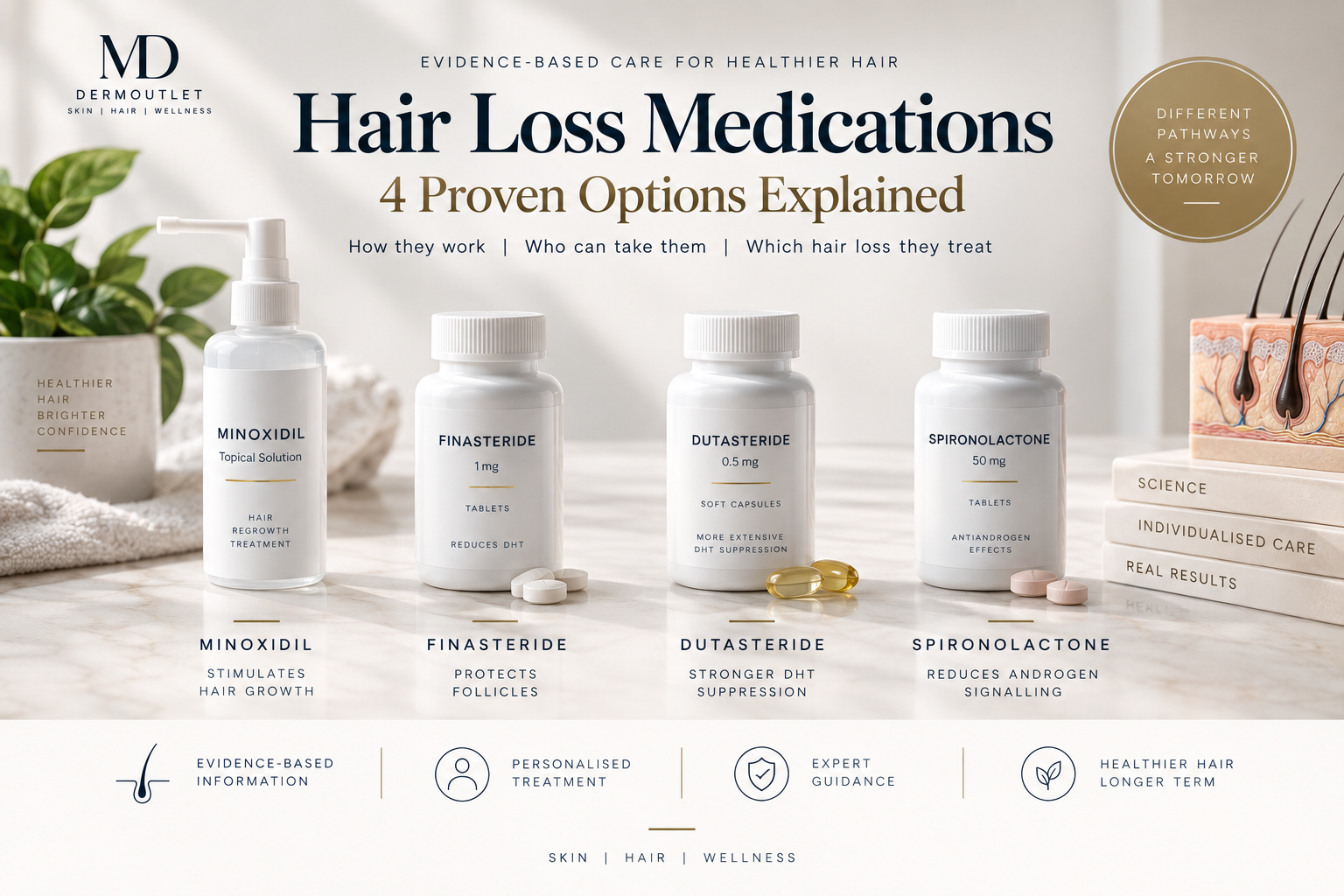
Hair loss medications such as minoxidil, finasteride, dutasteride and spironolactone can help manage certain types of hair loss. However, they work through different mechanisms and are not suitable for everyone. The right treatment depends on your diagnosis, medical history and whether viable hair follicles remain.
Some treatments stimulate the growth phase of surviving follicles, while others reduce the hormonal signals responsible for progressive thinning. Understanding that difference helps explain why the same prescription is not appropriate for every person.
Medical Disclaimer
This article provides general information and does not replace medical advice, diagnosis or treatment. Prescription hair-loss medications have contraindications, possible adverse effects and pregnancy-related precautions. Treatment should be selected by a qualified clinician after an individual assessment.
In a Nutshell: Hair Loss Medications
- Minoxidil helps stimulate growth from surviving follicles.
- Finasteride and dutasteride reduce dihydrotestosterone (DHT)-driven follicular miniaturisation.
- Spironolactone reduces androgen signalling and may help selected women with pattern hair loss.
- Combination treatment may be considered when medications target different mechanisms.
- Metformin is under investigation as an adjunct for central centrifugal cicatricial alopecia (CCCA); it is not an established general hair-loss treatment.
- No medication can restore a follicle permanently destroyed by scarring.
On This Page
- How the medications work
- Topical versus oral minoxidil
- Combining treatments
- Hair-care product recommendations
- Other types of alopecia
- Safety considerations
- Frequently asked questions
How Do Hair Loss Medications Work?
In androgenetic alopecia (pattern hair loss), genetically susceptible hair follicles gradually miniaturise. Over time, the hairs become finer and shorter, making the scalp more visible. Hair loss medications either promote growth from viable follicles or reduce the hormonal activity contributing to this process.
The main differences are summarised below. They do not create entirely new follicles; they help preserve or improve the function of follicles that are still alive.
On a phone, swipe across the table to read every column.
| Medication | How it works | Main use | Important considerations |
|---|---|---|---|
| Minoxidil | Supports the active (anagen) hair-growth phase, so viable follicles may produce longer, thicker hairs. | Male and female pattern hair loss; sometimes an adjunct for other alopecias. | Topical treatment is established; low-dose oral treatment is off-label and requires assessment and monitoring. |
| Finasteride | Mainly inhibits type II 5α-reductase, reducing conversion of testosterone to DHT. | Primarily androgenetic alopecia. | Usually prescribed to men; selected women may be considered by specialists. Important pregnancy precautions apply. |
| Dutasteride | Inhibits type I and II 5α-reductase, suppressing DHT more extensively. | Androgenetic alopecia and selected specialist-managed cases. | Not automatically the best choice despite greater DHT suppression; pregnancy precautions and prescribing status require review. |
| Spironolactone | Has antiandrogen activity, including androgen-receptor blockade. | Mainly female pattern hair loss. | Prescription treatment; assess pregnancy risk, blood pressure, kidney function and medicines affecting potassium. |
Topical vs Oral Minoxidil
Topical minoxidil is an established option for male and female pattern hair loss. It acts locally and may be preferred when someone wants to avoid systemic treatment.
Low-dose oral minoxidil is increasingly used off-label in selected patients. An international expert consensus statement provides guidance on patient selection, precautions and monitoring, but this does not mean the oral formulation is suitable for everyone.
A dermatologist may consider scalp sensitivity, ease of use, medical history, blood pressure and other medicines when deciding whether topical or oral treatment is appropriate. Read the international oral minoxidil consensus.
Can Hair Loss Medications Be Combined?
Yes. Combining treatments may be useful when they address different parts of the hair-loss process. Depending on the diagnosis, a dermatologist may consider minoxidil with finasteride, dutasteride or spironolactone. Combination treatment is individualised rather than a routine recommendation for everyone.
Medical treatment may also be combined with selected procedures. A 2025 meta-analysis found that microneedling combined with topical minoxidil improved hair-count outcomes compared with topical minoxidil alone in studies of androgenetic alopecia. Results and suitability depend on the procedure and patient.
The aim is not to use the greatest number of treatments. It is to select interventions with a reasonable evidence base that address the particular cause of hair loss.
Support Hair-Loss Treatment With the Right Hair Care
Medical treatment addresses the mechanisms driving hair loss. A suitable shampoo or conditioner can support scalp comfort and care for existing hair, but these products do not replace prescription therapy or reverse permanent follicular scarring.
For supportive hair care, consider the following MD DermOutlet products:


Explore hair-loss and scalp-care products at MD DermOutlet →
These are complementary hair-care choices, not equivalents of minoxidil, finasteride, dutasteride or spironolactone. Always assess persistent shedding, inflammation or scarring before relying on cosmetic products alone.
Can These Treatments Help Other Types of Alopecia?
Although the four main medications are best known for their use in pattern hair loss, dermatologists sometimes prescribe selected agents off-label as part of a broader plan for other hair-loss conditions. The underlying condition still needs appropriate treatment.
On a phone, swipe across the table to read every column.
| Condition | Possible supportive role | Important limitation |
|---|---|---|
| Alopecia areata | Minoxidil may support regrowth alongside disease-specific care. | It does not treat the autoimmune process. |
| CCCA | Minoxidil may support surviving follicles; metformin is being studied as an adjunct. | Treating active inflammation and scarring remains essential; metformin evidence is preliminary. |
| Frontal fibrosing alopecia (FFA) | Finasteride or dutasteride may be considered off-label; minoxidil may help viable follicles. | An anti-inflammatory treatment strategy may also be needed. |
| Lichen planopilaris (LPP) | Minoxidil may support surviving follicles or coexisting pattern hair loss. | It does not control the primary inflammatory disorder. |
| Traction alopecia | Minoxidil may be considered where follicles remain viable. | Removing persistent traction is the priority. |
| Telogen effluvium | Minoxidil may be considered in selected persistent cases. | Investigate and address the cause of excessive shedding. |
What About Metformin for CCCA?
Metformin is an emerging off-label option under investigation for central centrifugal cicatricial alopecia (CCCA), particularly because of its potential antifibrotic effects. It is not a proven general hair-regrowth medicine.
In a 2024 JAMA Dermatology case series involving 12 women with treatment-refractory CCCA, nine experienced improvement in disease symptoms or signs and six showed clinical evidence of regrowth after metformin was added to their existing treatment. This small, uncontrolled study is promising but cannot establish effectiveness for all patients. Read the original study.
Topical metformin has also been reported in small studies. Further research is required before it can be considered a standard treatment.
What Happens in End-Stage Scarring Alopecia?
Once a hair follicle is permanently destroyed and replaced by scar tissue, medications cannot regenerate it. Treatment can still be valuable when follicles survive at the edges or when disease activity threatens neighbouring areas.
This is why early diagnosis matters. Persistent scalp tenderness, burning, itching or visible scarring should prompt assessment rather than repeated changes to shampoo or over-the-counter products.
How Long Do Hair Loss Medications Take to Work?
Hair grows slowly, so changes are usually assessed over months rather than weeks. Reduced shedding may be noticed before a visible improvement in thickness or density.
For chronic androgenetic alopecia, continued treatment is often needed to maintain the benefit. An individual treatment plan should explain expected timelines, follow-up and when a response should be reassessed.
Important Safety Considerations
Prescription hair-loss medications are not suitable for everyone, and safety checks differ between treatments:
- Oral minoxidil: review cardiovascular history, blood pressure and possible adverse effects.
- Finasteride and dutasteride: discuss reproductive precautions, contraindications and other potential adverse effects; they must not be used during pregnancy.
- Spironolactone: consider pregnancy risk, blood pressure, kidney function and medications that may raise potassium.
- Off-label prescribing: discuss the evidence, uncertainties and monitoring requirements with the treating dermatologist.
Never start, combine or stop prescription medicines based solely on an online article.
Considering Prescription Hair-Loss Treatment?
A dermatologist can identify the type of alopecia, assess whether follicles remain viable and recommend an individualised plan. This is especially important when hair loss is rapidly progressive, associated with scalp symptoms or possibly scarring.
Find consultation information for Dr Matete Mathobela →
Dermatologist’s Perspective
The most useful question is not “Which hair loss medication is strongest?” but “What is causing the hair loss?” Minoxidil primarily promotes follicular growth, whereas finasteride, dutasteride and spironolactone reduce androgen effects through different pathways.
In selected conditions, supportive medicines may be used off-label. However, controlling inflammation in scarring alopecia and preserving viable follicles remain central to successful management.
Frequently Asked Questions About Hair Loss Medications
Which hair loss medication is best?
There is no single best option. Treatment depends on the diagnosis, medical history, reproductive considerations, tolerability and whether follicles remain viable.
Is dutasteride stronger than finasteride?
Dutasteride generally suppresses DHT more extensively because it inhibits both type I and II 5α-reductase. More extensive suppression does not automatically mean it is the safest or most suitable treatment for every patient.
Can medication reverse scarring alopecia?
Selected medicines can support surviving follicles, and some may be used for conditions such as frontal fibrosing alopecia. However, a follicle permanently replaced by scar tissue cannot be restored by these treatments.
Will I need to use hair loss medications indefinitely?
Androgenetic alopecia is chronic, so continued treatment is generally needed to maintain the improvement. Treatment duration for other diagnoses depends on the underlying cause and response.
Related Reading
References
- Akiska YM, et al. Low-Dose Oral Minoxidil Initiation for Patients With Hair Loss: An International Modified Delphi Consensus Statement. JAMA Dermatology. 2025. PubMed.
- Gupta AK, Venkataraman M, Talukder M, Bamimore MA. Relative Efficacy of Minoxidil and the 5-α Reductase Inhibitors in Androgenetic Alopecia Treatment of Male Patients: A Network Meta-analysis. JAMA Dermatology. 2022. PubMed.
- Aleissa M. The Efficacy and Safety of Oral Spironolactone in the Treatment of Female Pattern Hair Loss: A Systematic Review and Meta-Analysis. Cureus. 2023. PubMed.
- Ahmed KMA, et al. Evaluating the Efficacy and Safety of Combined Microneedling Therapy Versus Topical Minoxidil in Androgenetic Alopecia: A Systematic Review and Meta-analysis. Archives of Dermatological Research. 2025. PubMed.
- Bao A, et al. Low-Dose Metformin and Profibrotic Signature in Central Centrifugal Cicatricial Alopecia. JAMA Dermatology. 2024. PubMed.