





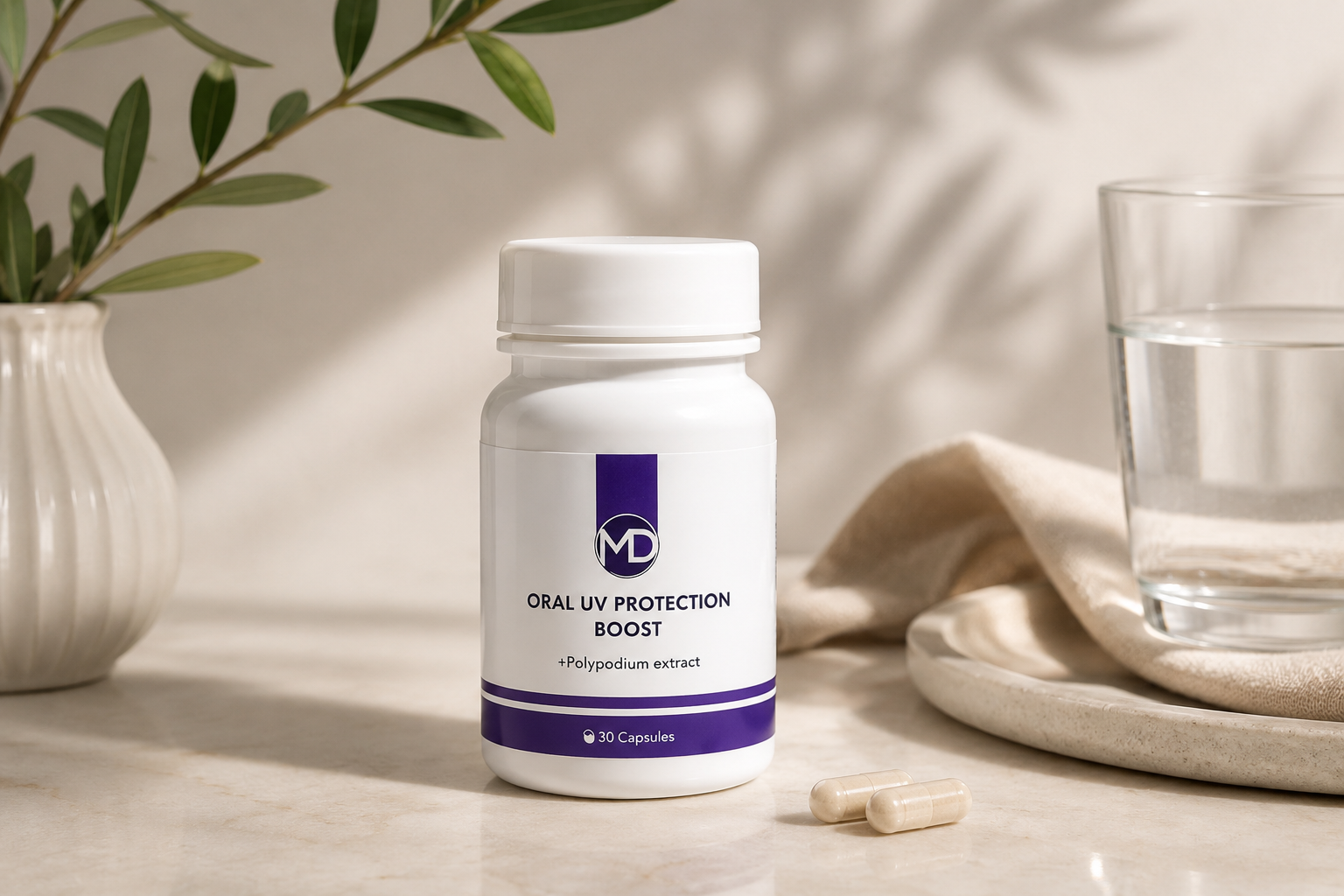
Polypodium Leucotomos for Skin: Does Oral Photoprotection Really Work?
By Dr Matete Mathobela
Reviewed by Dr Matete Mathobela – Specialist Dermatologist practising in Century City, Cape Town, Cape Gate Mediclinic and Life West Coast Private Hospital. Founder of MD Cosmeceuticals by Matete Derma and MD DermOutlet.
Read more about Dr Matete Mathobela →
Medical Disclaimer
This article is for general educational purposes and does not replace individual medical advice. Polypodium leucotomos should be considered an adjunct to appropriate photoprotection and, where relevant, dermatologist-directed treatment.
Polypodium leucotomos for skin is an oral antioxidant supplement increasingly used as an adjunct to photoprotection. Research suggests it may help reduce some of the biological effects of ultraviolet radiation, but it should be used alongside—not instead of—topical sunscreen and other sun-protective measures.
What Is Polypodium Leucotomos?
Polypodium leucotomos is a fern extract used as an oral photoprotective antioxidant. It is sometimes described as providing photoprotection “from within”, but it is important to understand that it is not an oral sunscreen and does not replace topical sunscreen.
Research suggests that Polypodium leucotomos may help the skin respond to ultraviolet (UV) exposure through antioxidant, anti-inflammatory and immunomodulatory effects.
A recent systematic review identified potential applications across photoageing and UV-related skin damage, actinic keratoses, photodermatoses, melasma, vitiligo and atopic dermatitis. However, the strength of evidence differs considerably between these conditions.
How Does Polypodium Leucotomos for Skin Work?
UV exposure does more than cause sunburn. It contributes to oxidative stress, inflammation and cellular damage, all of which may contribute to pigmentation and photoageing.
Polypodium leucotomos may provide an additional layer of protection by helping to:
- Reduce UV-induced oxidative stress
- Reduce inflammatory responses triggered by UV exposure
- Support the skin’s defence against photodamage
- Reduce some of the cellular effects associated with UV exposure
These effects supplement conventional photoprotection rather than replace it.
Where Can Polypodium Leucotomos Be Useful?
1. Melasma
Melasma is strongly influenced by light exposure, which is why effective management usually requires more than a pigment-correcting serum alone.
Polypodium leucotomos has been investigated as an adjunct to conventional melasma treatment.
In one placebo-controlled trial, adding oral Polypodium leucotomos to hydroquinone 4% and SPF50+ sunscreen was associated with earlier improvement compared with placebo.
The key word is adjunct. Polypodium leucotomos should be added to a comprehensive melasma treatment plan rather than used instead of sunscreen or pigment-directed treatment.
2. Photodermatoses
Polypodium leucotomos has also been investigated in photosensitive skin disorders, particularly polymorphic light eruption.
Clinical studies have reported reductions in UV-induced skin reactions and symptoms in some patients with idiopathic photodermatoses.
It may therefore provide additional photoprotection in appropriately selected patients.
3. Lupus and Other Photosensitive Skin Diseases
Strict photoprotection is particularly important in photosensitive diseases such as cutaneous lupus and systemic lupus erythematosus (SLE).
Polypodium leucotomos may be considered as additional photoprotective support in selected patients, but evidence specifically demonstrating benefit in lupus remains limited.
It should not be presented as a treatment for SLE or cutaneous lupus and does not replace appropriate medical management.
4. Lichen Planus Pigmentosus
Photoprotection may form an important part of managing lichen planus pigmentosus (LPP), particularly when pigmentation affects sun-exposed areas.
Polypodium leucotomos can therefore be considered as an additional oral photoprotective measure in selected patients.
However, there is currently insufficient evidence to claim that Polypodium leucotomos directly treats LPP. Its role is supportive rather than a replacement for treatment of the underlying inflammatory and pigmentary disorder.
5. Vitiligo
Polypodium leucotomos has also been studied as an adjunct to narrow-band UVB (NB-UVB) phototherapy for vitiligo.
Randomised studies suggest that adding oral Polypodium leucotomos to NB-UVB may improve repigmentation compared with NB-UVB alone.
NB-UVB is a controlled medical phototherapy treatment and should not be confused with natural sun exposure.
Polypodium leucotomos should therefore be viewed as a potential adjunct to phototherapy, not a standalone treatment for vitiligo.
What Does the Evidence Support?
| Skin concern | Potential role |
|---|---|
| Melasma | Adjunct to sunscreen and pigment-directed treatment |
| Photodermatoses | Additional systemic photoprotection |
| SLE / cutaneous lupus | Potential adjunctive photoprotection; direct evidence is limited |
| Lichen planus pigmentosus | Supportive photoprotection; direct treatment evidence is limited |
| Vitiligo | Studied as an adjunct to NB-UVB phototherapy |
| Photoageing / UV damage | Antioxidant and photoprotective support |
The evidence is therefore not equally strong for every indication. Polypodium leucotomos for skin is best considered an adjunctive photoprotective strategy rather than a treatment for all of these conditions.
Does Polypodium Leucotomos Replace Sunscreen?
No. Polypodium leucotomos does not replace sunscreen.
Think of it as additional oral photoprotection, used alongside:
- Broad-spectrum sunscreen
- Protective clothing and shade where appropriate
- Sensible sun behaviour
For pigmentation disorders such as melasma, a tinted sunscreen containing iron oxides may provide additional protection against visible light.
Polypodium leucotomos is the extra layer — sunscreen remains the foundation.
Who Might Benefit Most?
I am most likely to consider oral photoprotection when light exposure plays an important role in a patient’s skin condition.
This may include selected patients with:
- Melasma
- Recurrent or difficult-to-control pigmentation
- Significant photosensitivity
- Photodermatoses
- Photosensitive inflammatory skin disease
- LPP where photoprotection forms part of the management strategy
- Vitiligo patients undergoing dermatologist-directed NB-UVB phototherapy
It is not something everyone needs simply because they use skincare.
Considering Additional Oral Photoprotection?
Shop MD Polypodium Leucotomos →
Polypodium leucotomos can provide additional photoprotective support in selected patients and should be used alongside—not instead of—appropriate sunscreen and other sun-protective measures.
My Dermatologist’s Perspective
I see Polypodium leucotomos for skin as an additional layer of photoprotection, not a replacement for sunscreen or treatment of the underlying skin condition.
I consider it particularly useful in selected patients with melasma, significant photosensitivity or other conditions where light exposure may contribute to disease or pigmentation.
The foundation remains the same: the correct diagnosis, appropriate treatment, sunscreen and sensible sun protection. Oral photoprotection can then be added where there is a good clinical reason to do so.
— Dr Matete Mathobela, Specialist Dermatologist
Frequently Asked Questions
Is Polypodium leucotomos for skin an oral sunscreen?
No. Although it has systemic photoprotective and antioxidant effects, it does not provide an SPF and cannot replace topical sunscreen.
Can Polypodium leucotomos help melasma?
Potentially. It has been studied as an adjunct to sunscreen and pigment-directed treatment, with some clinical studies demonstrating additional benefit.
Can Polypodium leucotomos be used for lupus?
It may be considered as additional photoprotective support in selected photosensitive patients, but it does not treat SLE or replace medical therapy. Evidence specifically supporting its use in lupus remains limited.
Can it be used for lichen planus pigmentosus?
It may be considered as an adjunctive photoprotective measure, particularly where sun exposure contributes to pigmentation. However, there is insufficient evidence to claim that Polypodium leucotomos directly treats LPP.
Can Polypodium leucotomos help vitiligo?
It has been studied as an adjunct to medically administered narrow-band UVB phototherapy. Randomised studies suggest that the combination may improve repigmentation compared with NB-UVB alone.
This does not mean that Polypodium should be combined with deliberate natural sun exposure as a treatment for vitiligo.
Does Polypodium leucotomos prevent skin ageing?
Its antioxidant and photoprotective properties may help reduce some of the biological effects of UV exposure that contribute to photoageing.
However, it is better described as supportive photoprotection rather than an oral anti-ageing treatment.
Not Sure What Is Causing Your Pigmentation or Photosensitivity?
Conditions such as melasma, post-inflammatory hyperpigmentation and photosensitive skin disorders require different approaches. A dermatologist can help establish the diagnosis and determine whether additional oral photoprotection is appropriate for you.
Book an appointment with Dr Matete Mathobela →
Suggested Reading
- MD MelanClear for Pigmentation: How Does It Work?
- Hyperpigmentation: Causes, Treatments and Dermatologist Advice
- MD Cosmeceuticals: A Dermatologist Skincare Routine That Actually Works
References
Zundell MP, et al. The Utility of Oral Polypodium Leucotomos Extract for Dermatologic Diseases: A Systematic Review. Journal of Drugs in Dermatology. 2025.
Read the systematic review on PubMed
Goh CL, et al. Double-blind, Placebo-controlled Trial to Evaluate the Effectiveness of Polypodium Leucotomos Extract in the Treatment of Melasma in Asian Skin: A Pilot Study. Journal of Clinical and Aesthetic Dermatology. 2018.
Read the melasma study on PubMed
Middelkamp-Hup MA, et al. Treatment of vitiligo vulgaris with narrow-band UVB and oral Polypodium leucotomos extract: a randomized double-blind placebo-controlled study. Journal of the European Academy of Dermatology and Venereology. 2007.
Read the vitiligo study on PubMed
Pacifico A, et al. NB-UVB plus oral Polypodium leucotomos extract display higher efficacy than NB-UVB alone in patients with vitiligo.
Read the study on PubMed
Caccialanza M, et al. Oral Polypodium leucotomos extract photoprotective activity in patients with idiopathic photodermatoses.
Read the photodermatoses study on PubMed
Like & Share