




MD Retinoid Cream: How This Advanced Retinoid Works
By Dr Matete Mathobela
Reviewed by Dr Matete Mathobela – Specialist Dermatologist practising in Century City, Cape Town, Cape Gate Mediclinic and Life West Coast Private Hospital. Founder of MD Cosmeceuticals by Matete Derma and MD DermOutlet.
Read more about Dr Matete Mathobela →
Medical Disclaimer
This article is for general educational purposes and does not replace individual medical advice. Retinoids can cause irritation and are not suitable for everyone. Avoid topical retinoids during pregnancy unless specifically advised otherwise by your healthcare professional.
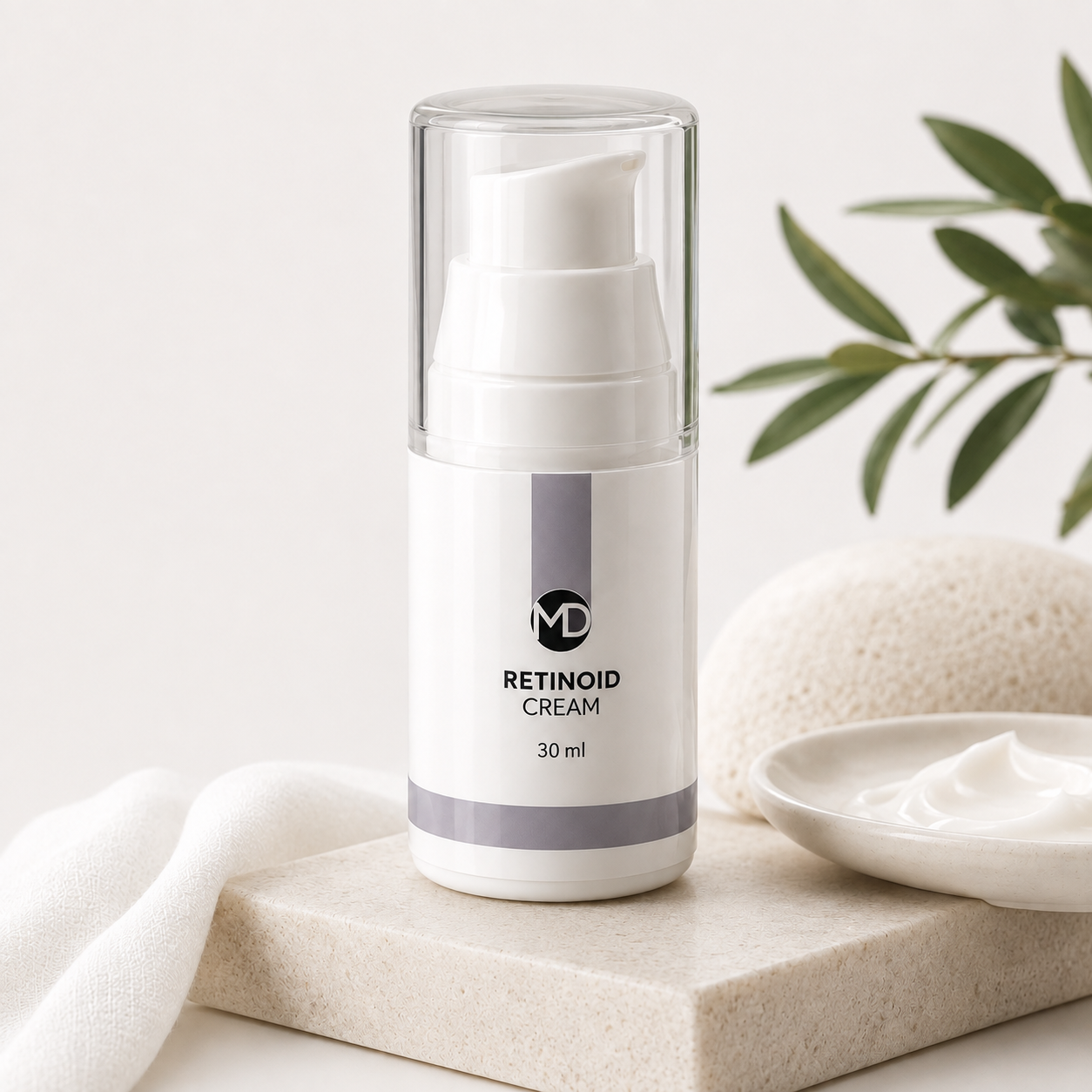
MD Retinoid Cream is a multi-active cosmetic retinoid formulated with Hydroxypinacolone Retinoate (HPR), bakuchiol, nicotinamide (niacinamide) and an azelaic-acid derivative.
It is designed to target several concerns commonly addressed with retinoids:
- Fine lines and early signs of ageing
- Uneven skin texture
- Pigmentation and post-acne marks
- Blemish-prone skin
What Is the Retinoid in MD Retinoid Cream?
MD Retinoid Cream contains Hydroxypinacolone Retinoate (HPR) rather than conventional retinol.
HPR is an ester of retinoic acid that can interact directly with retinoid receptors without first requiring conversion to retinoic acid.
| Retinoid | Pathway before receptor activity |
|---|---|
| Retinol | Retinol → retinaldehyde → retinoic acid |
| Retinaldehyde | Retinaldehyde → retinoic acid |
| HPR | Does not require conversion to retinoic acid |
| Tretinoin | Already retinoic acid |
This doesn’t mean HPR is equivalent to prescription retinoids, which have a much larger and more established clinical evidence base.
Is HPR More Active Than Retinol?
Possibly. Emerging evidence suggests HPR may provide substantial biological activity at relatively low concentrations.
Laboratory research has found greater retinoid-related gene transcription with HPR than with retinol, retinaldehyde and retinyl palmitate at equivalent concentrations, although activity remained below all-trans retinoic acid.
Clinical research is also encouraging. A recent split-face study comparing 0.03% 9-cis HPR with 0.3% retinol found comparable or superior improvements across several measures of photoageing with 9-cis HPR.
This does not mean HPR is simply “10 times stronger than retinol”. The study was small, and the 9-cis HPR studied should not automatically be considered equivalent to every HPR formulation.
Overall, the emerging evidence suggests that HPR is more than simply a gentler alternative to retinol—it has meaningful retinoid activity of its own.
What Are the Key Ingredients in MD Retinoid Cream?
MD Retinoid Cream combines HPR with complementary ingredients rather than relying on the retinoid alone.
| Ingredient | Main role |
|---|---|
| HPR | Retinoid activity supporting skin renewal, texture and signs of photoageing |
| Bakuchiol | Complementary antioxidant and skin-ageing support |
| Nicotinamide | Barrier support and helps reduce melanosome transfer |
| Azelamidopropyl Dimethyl Amine | Azelaic-acid derivative supporting blemish-prone and uneven-toned skin |
| Jojoba oil | Emollient support and skin comfort |
This makes the formulation particularly useful when ageing, pigmentation, uneven texture and blemish-prone skin overlap.
What Can MD Retinoid Cream Help With?
| Skin concern | Potential role |
|---|---|
| Fine lines / photoageing | Retinoid activity + bakuchiol |
| Uneven texture | Supports epidermal renewal |
| Pigmentation / PIH | HPR + niacinamide + azelaic-acid derivative |
| Blemish-prone skin | Retinoid activity with complementary ingredients |
Clinical studies of HPR-containing formulations have demonstrated improvements in wrinkles, texture, elasticity and pigmentation. However, many used multi-active formulations, so the results cannot be attributed to HPR alone.
What About Acne?
HPR has also been studied in multi-active formulations for mild-to-moderate acne, with reductions in acne lesions reported.
The evidence is promising, but HPR does not currently have the same clinical evidence base as established prescription retinoids. Moderate, severe or persistent acne may require dermatologist-directed treatment.
Can MD Retinoid Cream Help Pigmentation?
MD Retinoid Cream can be particularly useful when pigmentation occurs alongside uneven texture or blemish-prone skin.
The formulation approaches uneven tone through several pathways:
- HPR – supports epidermal renewal
- Niacinamide – helps reduce melanosome transfer into keratinocytes
- Azelamidopropyl Dimethyl Amine – additional support for uneven tone
- Bakuchiol – complementary antioxidant support
Persistent melasma or significant hyperpigmentation usually requires a broader treatment strategy rather than relying on a retinoid alone.
What Can I Combine With MD Retinoid Cream?
The best combination depends on what you are trying to treat.
| Main concern | MD combination |
|---|---|
| Fine lines, texture & photoageing | MD Niacinamide Peptide Serum + MD Retinoid Cream |
| Pigmentation & post-acne marks | MD MelanClear + MD Retinoid Cream |
For Anti-Ageing: Niacinamide Peptide Serum + MD Retinoid Cream
MD Retinoid Cream can be combined with MD Niacinamide Peptide Serum when the main goal is anti-ageing.
The products have complementary roles:
- Niacinamide Peptide Serum provides peptide, niacinamide and barrier-supportive care.
- MD Retinoid Cream provides the primary HPR-led retinoid activity.
There is clinical precedent for combining HPR with peptides. In a 16-week clinical study, a formulation containing 0.1% HPR plus a peptide complex improved several measures of facial photoageing, including fine lines, wrinkles and skin texture.
This study did not investigate these specific MD products, but it supports the rationale for combining retinoid and peptide-based skincare in an anti-ageing routine.
Evening:
Cleanser → MD Niacinamide Peptide Serum → MD Retinoid Cream → Moisturiser if needed
For Pigmentation: MelanClear + MD Retinoid Cream
MD Retinoid Cream and MD MelanClear can also be used together in appropriately tolerant skin.
Evening:
Cleanser → MD MelanClear → MD Retinoid Cream → Moisturiser if needed
If you have sensitive skin or are new to active skincare, initially alternate the products rather than introducing both together.
How Do I Use MD Retinoid Cream?
MD Retinoid Cream should be introduced gradually, particularly if you are new to retinoids.
- Start 2–3 evenings per week
- Apply a small amount to dry skin
- Increase frequency according to tolerance
- Follow with moisturiser if needed
- Use broad-spectrum sunscreen every morning
Retinoids do not need to cause peeling or irritation to be effective.
My Dermatologist’s Perspective
I chose HPR for MD Retinoid Cream because it offers an interesting alternative to conventional retinol. It can interact directly with retinoid receptors without first requiring conversion to retinoic acid, and emerging research suggests meaningful biological activity with potentially good tolerability.
I also wanted the formulation to address more than ageing alone. Combining HPR with bakuchiol, niacinamide and an azelaic-acid derivative makes it useful when pigmentation, uneven texture or blemish-prone skin occur alongside early signs of ageing.
For anti-ageing, I particularly like pairing it with MD Niacinamide Peptide Serum. For pigmentation, MD MelanClear provides a more pigment-focused combination.
MD Retinoid Cream remains a cosmetic retinoid and should not be considered a substitute for prescription retinoids when these are clinically indicated.
— Dr Matete Mathobela, Specialist Dermatologist
Shopping for professional skincare online? Read our guide to buying authentic dermatologist-recommended skincare.
Ready to Add a Retinoid to Your Routine?
Not sure which retinoid or combination is right for your skin?
Book an appointment with Dr Matete Mathobela →
Frequently Asked Questions
Is MD Retinoid Cream the same as retinol?
No. MD Retinoid Cream contains HPR, which belongs to the retinoid family but is chemically different from retinol. HPR does not require conversion to retinoic acid before interacting with retinoid receptors.
Is HPR stronger than retinol?
Emerging evidence suggests HPR may provide substantial biological activity at relatively low concentrations. However, there is not yet enough evidence to establish a reliable potency conversion between HPR and retinol.
Is HPR better than retinaldehyde?
We don’t know yet. Laboratory research suggests HPR may have greater biological activity in some experimental models, but retinaldehyde has a more established clinical evidence base. Larger head-to-head clinical studies are needed.
Can MD Retinoid Cream be used for acne?
It may be useful for mild congestion and blemish-prone skin, but it does not replace prescription retinoids or other dermatologist-directed acne treatments where these are indicated.
Can MD Retinoid Cream be used with a peptide serum?
Yes. MD Niacinamide Peptide Serum can be used before MD Retinoid Cream as part of an anti-ageing routine.
Can MD Retinoid Cream be used with MelanClear?
Yes, if your skin tolerates both products. They can be layered in the evening or initially alternated if your skin is sensitive.
Other HPR Retinoids at MD DermOutlet
MD Retinoid Cream isn’t the only HPR-containing retinoid option available at MD DermOutlet.
Lamelle Correctives RA Advance Cream, for example, combines HPR with retinaldehyde, offering a different approach for someone looking for a multi-retinoid formulation.
Shop Lamelle Correctives RA Advance Cream →
Suggested Reading
- MD MelanClear for Pigmentation: How Does It Work?
- How to Layer Skincare Products: A Dermatologist’s Guide
- Hyperpigmentation: Causes, Treatments and Dermatologist Advice
- MD Cosmeceuticals: A Dermatologist Skincare Routine for Healthy, Resilient Skin
References
Shen Y, et al. An Innovative Serum With Retinol, Hydroxypinacolone Retinoate, Peptides, and Silybin Improves Mild Photoaged Facial Skin in Middle-Aged Chinese Women. Journal of Cosmetic Dermatology. 2026.
Kruger L, et al. Efficacy of Topical Hydroxypinacolone Retinoate-Peptide Product Versus Fractional CO₂ Laser in Facial Aging. Journal of Cosmetic Dermatology. 2025. The study evaluated 0.1% HPR combined with peptides and reported improvements across several measures of facial photoageing.
Hydroxypinacolone 9-cis retinoate and photoageing. Journal of Investigative Dermatology. 2026. Includes a split-face comparison of 0.03% 9-cis HPR with 0.3% retinol.
Veraldi S, et al. Clinical study of an HPR, retinol glycospheres and papain combination in mild-to-moderate acne.
Villani A, et al. Clinical evaluation of a multi-active formulation containing HPR, encapsulated retinol, niacinamide and acne-targeting ingredients.
Like & Share