





Bioderma Pigmentbio vs Mela B3: Which Is Better for Dark Spots?
By Dr Matete Mathobela
Reviewed by Dr Matete Mathobela – Specialist Dermatologist practising in Century City, Cape Town, Cape Gate Mediclinic and Life West Coast Private Hospital. Founder of MD Cosmeceuticals by Matete Derma and MD DermOutlet.
Read more about Dr Matete Mathobela →
Medical Disclaimer: This article is for educational purposes only and does not replace individual medical advice. Persistent, unexplained or changing pigmentation should be assessed by a healthcare professional.
Introduction
If you are comparing Bioderma Pigmentbio vs Mela B3, both ranges are designed to address dark spots and uneven skin tone, but they approach pigmentation differently.
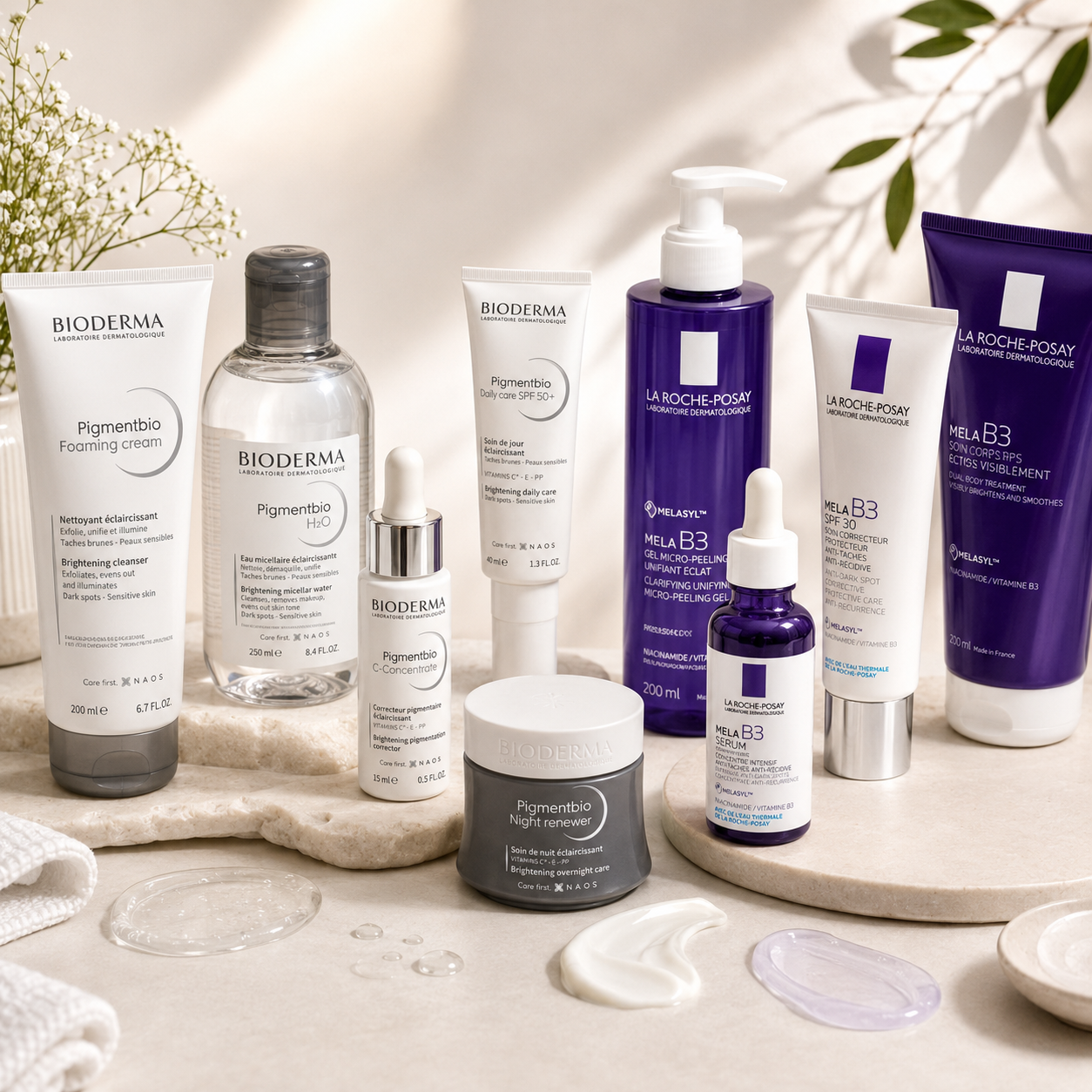
Bioderma Pigmentbio offers several products that can be selected across a pigmentation routine, including cleansing, targeted treatment, moisturising care, photoprotection and treatment for sensitive or friction-prone areas. Bioderma South Africa currently lists six products in the range. (Bioderma South Africa)
La Roche-Posay Mela B3 is centred around Melasyl™, with the current South African range including Mela B3 Cleanser, Serum and SPF30. (La Roche-Posay Africa)
The important question is therefore not simply “Which range is better?”
It is:
“Which product or approach is better suited to my pigmentation, my skin and the treatments I already use?”
Quick Answer: Bioderma Pigmentbio vs Mela B3
There is no universal winner between Bioderma Pigmentbio vs Mela B3.
Bioderma Pigmentbio may suit someone who wants more flexibility across different steps of a pigmentation routine. Its range includes products for cleansing, more intensive pigment correction, daytime and night-time care, and sensitive areas.
Mela B3 offers a more targeted Melasyl™-based approach, with products designed to cleanse, correct and provide daytime care. (La Roche-Posay Africa)
For facial pigmentation, the most useful head-to-head comparison is often Pigmentbio C-Concentrate vs Mela B3 Serum.
For pigmentation affecting the body or friction-prone areas, we can also compare Pigmentbio Sensitive Areas with Mela B3 Dual Action Body Treatment, which La Roche-Posay US states has been tested on sensitive areas from the underarms to the bikini area.
Bioderma Pigmentbio vs Mela B3 at a Glance
| Bioderma Pigmentbio | La Roche-Posay Mela B3 | |
|---|---|---|
| Main approach | Broad pigmentation skincare range | Pigmentation range centred around Melasyl™ |
| Main facial treatment | Pigmentbio C-Concentrate | Mela B3 Serum |
| Exfoliation | More prominent in C-Concentrate and Foaming Cream | Depends on the individual product |
| Body/sensitive areas | Pigmentbio Sensitive Areas | Mela B3 Dual Action Body Treatment* |
| Routine options | Cleansing, treatment, moisturising, SPF and sensitive-area care | Cleanser, serum and SPF30 in the current SA range |
| Best choice | Depends on pigmentation, sensitivity and existing treatments | Depends on pigmentation, sensitivity and existing treatments |
*Mela B3 Dual Action Body Treatment is referenced from La Roche-Posay’s US range.
Ready to explore the products? Shop the Bioderma Pigmentbio range or shop the La Roche-Posay Mela B3 range at MD DermOutlet.
What Is the Main Difference?
The main difference between Bioderma Pigmentbio vs Mela B3 is the way their pigment-correcting products are formulated and how they can be incorporated into a routine.
Pigmentbio provides multiple options across different skincare steps. However, this doesn’t mean you need the entire range. Someone using C-Concentrate, for example, may benefit from keeping the rest of the routine relatively simple to avoid unnecessary irritation.
Mela B3 is particularly distinguished by Melasyl™, which La Roche-Posay describes as intercepting excess melanin before it marks the skin.
Neither approach is automatically better.
As a dermatologist, I would choose between them according to the type and location of pigmentation, skin sensitivity, current treatments and how much active treatment the skin can tolerate.
Pigmentbio C-Concentrate vs Mela B3 Serum
For facial pigmentation, this is probably the most useful direct comparison within the two ranges. Both are targeted treatments for dark spots, but their formulations approach pigmentation differently.
How Do They Target Pigmentation?
Pigmentbio C-Concentrate takes a multi-active approach, combining vitamin C with exfoliating and pigment-correcting ingredients. Its AHA/BHA component also promotes surface renewal. (mddermoutlet.co.za)
Mela B3 Serum is centred around Melasyl™, which La Roche-Posay describes as intercepting excess melanin before it marks the skin. It is combined with niacinamide and LHA.
| Pigmentbio C-Concentrate | Mela B3 Serum | |
|---|---|---|
| Main approach | Multi-active pigment correction + exfoliation | Melasyl™-centred pigment correction |
| Key features | Vitamin C + exfoliating/pigment-targeting ingredients | Melasyl™ + niacinamide + LHA |
| Exfoliation | More prominent | Gentler exfoliating component |
| How often | Bioderma recommends an evening treatment course | Morning and/or evening |
| Retinoid users | I generally simplify the routine and temporarily stop retinoids when first introducing it | May be easier to incorporate, but overall tolerability still matters |
| Best suited to | Someone wanting a more intensive treatment-course approach | Someone wanting an easy-to-incorporate targeted serum |
Which Would I Choose?
I wouldn’t choose purely according to which product has the longest ingredient list.
For someone who wants a more intensive pigment-correcting and exfoliating treatment course, I may favour Pigmentbio C-Concentrate, provided their skin tolerates it.
For someone who wants a targeted serum that is easier to incorporate into an existing routine, Mela B3 Serum may be the more practical option. La Roche-Posay recommends 2–3 drops morning and/or evening, either alone or under moisturiser.
Neither is automatically stronger or better. The best choice is the one that targets your pigmentation while fitting comfortably into the rest of your skincare routine.
Body and Sensitive-Area Pigmentation
Both Bioderma Pigmentbio and Mela B3 offer options for pigmentation affecting the body and sensitive areas, although the specific product availability differs by market.
Pigmentbio Sensitive Areas is specifically designed for delicate, friction-prone areas. The formulation available through MD DermOutlet is intended for areas including the underarms, inner thighs, knees, elbows and bikini line.
La Roche-Posay Mela B3 Dual Action Body Treatment is designed for dark spots and uneven skin tone on the body. Importantly, La Roche-Posay US states that it has been tested on sensitive areas from the underarms to the bikini area.
Pigmentbio Sensitive Areas vs Mela B3 Dual Action Body Treatment
| Pigmentbio Sensitive Areas | Mela B3 Dual Action Body Treatment | |
|---|---|---|
| Main role | Targeted pigmentation care for delicate, friction-prone areas | Pigment-correcting treatment for the body |
| Sensitive areas | Yes | Yes – tested from underarms to bikini area |
| Particularly useful for | Localised pigmentation of underarms, knees, elbows and external intimate areas | Sensitive areas as well as larger areas of body pigmentation |
| Key approach | Pigment correction with soothing care for delicate areas | Melasyl™ + niacinamide + exfoliating LHA |
| How I would choose | When I want a product specifically focused on localised delicate/friction-prone areas | When I want a broader body treatment that can also be used on sensitive areas |
So Pigmentbio Sensitive Areas is not the only option for sensitive-area pigmentation. Mela B3 Dual Action Body Treatment can also be considered for areas such as the underarms and bikini area.
The choice may therefore come down to the area being treated, the extent of the pigmentation, the formulation you prefer and how your skin tolerates the product.
It is also important to address the cause. Friction, shaving, waxing and previous inflammation can all contribute to darkening. If the trigger continues, pigment-correcting skincare alone may give limited results.
Treat the cause of the pigmentation as well as the pigmentation itself.
Can You Use Bioderma Pigmentbio and Mela B3 Together?
Yes. You do not have to choose one range and use it exclusively.
Pigmentation develops through several biological processes, and Pigmentbio and Mela B3 use different combinations of ingredients to influence pigment formation, inflammation and skin renewal.
This means you can choose the product that works best for each step of your routine.
For example, if Pigmentbio Daily Care SPF50+ leaves an ashy finish, you could continue using Pigmentbio C-Concentrate but choose Mela B3 SPF30 or another suitable daytime product. However, La Roche-Posay specifically notes that Mela B3 SPF30 is not a dedicated suncare product and recommends an appropriate sunscreen for intense or prolonged sun exposure.
If you prefer Mela B3 Serum as your targeted treatment but want a dedicated night moisturiser, you could use Pigmentbio Night Renewer.
You can also combine selected products from both ranges if they complement your routine and your skin tolerates them well.
My Approach to Mixing the Ranges
I prefer to choose the best product for each step rather than insisting that every product comes from the same range.
However, targeting different aspects of pigmentation does not mean that more active ingredients will necessarily give better results. If a combination causes persistent dryness, stinging, peeling or inflammation, simplify the routine.
For pigmentation-prone skin, a complementary but well-tolerated routine is more important than using as many pigment-correcting ingredients as possible.
Which Is Better — Bioderma Pigmentbio or Mela B3?
There is no single winner. The better choice depends on the type and location of your pigmentation, your skin sensitivity, your current routine and how your skin tolerates active ingredients.
Which Would I Choose?
| If you are looking for… | I would consider… |
|---|---|
| A more intensive treatment-course approach for facial pigmentation | Pigmentbio C-Concentrate |
| A targeted serum that is easy to incorporate into an existing routine | Mela B3 Serum |
| A dedicated night moisturiser for pigmentation-prone skin | Pigmentbio Night Renewer |
| Localised pigmentation of delicate or friction-prone areas | Pigmentbio Sensitive Areas |
| Body pigmentation, including sensitive areas | Mela B3 Dual Action Body Treatment |
| A complete routine from one range | Either, depending on your skin and product preferences |
| The best individual products for your skin | Products from both ranges can be combined when appropriate |
My Dermatologist’s Recommendation
For facial pigmentation, I may consider Pigmentbio C-Concentrate when I want a more intensive treatment-course approach and the skin can tolerate it.
Mela B3 Serum may be more practical when I want a targeted serum that can fit easily into an existing routine. La Roche-Posay describes it as having very good tolerance, including for sensitive skin.
For body or sensitive-area pigmentation, both ranges have useful options, so I would choose according to the location and extent of the pigmentation, the formulation and the patient’s tolerance rather than assuming one brand is automatically better.
And remember, you don’t have to choose one range exclusively. I prefer choosing the most appropriate product for each step of the routine, even if that means combining Pigmentbio and Mela B3 products.
Most importantly, persistent pigmentation should not simply be treated with progressively more brightening products. Identifying and treating the cause of the pigmentation remains more important than choosing between two skincare brands.
Not sure what is causing your pigmentation or which treatment is appropriate? Book an appointment with Dr Matete Mathobela for an individual dermatological assessment.
Frequently Asked Questions About Bioderma Pigmentbio vs Mela B3
Is Mela B3 better than Bioderma Pigmentbio for dark spots?
Not necessarily. Mela B3 Serum may be easier to incorporate as a targeted daily serum, while Pigmentbio C-Concentrate offers a more intensive treatment-course approach. The better option depends on your pigmentation, skin sensitivity and existing routine.
Can I use Mela B3 Serum with Pigmentbio C-Concentrate?
I would not routinely start both targeted treatments at the same time. Pigmentbio C-Concentrate already contains several active ingredients, including exfoliating ingredients, so I prefer keeping the routine simple when introducing it. Other products can be added according to tolerance.
Can I use Bioderma Pigmentbio and Mela B3 products in the same routine?
Yes. You don’t have to stay within one brand. You can select products from either range according to what your skin needs, provided the overall routine is appropriate and well tolerated.
Which is better for sensitive skin: Pigmentbio or Mela B3?
This depends more on the individual product than the range itself. Sensitive or easily irritated skin generally benefits from introducing pigment-correcting treatments gradually and avoiding unnecessary combinations of exfoliating products.
Which is better for melasma: Bioderma Pigmentbio or Mela B3?
Either range can form part of a melasma skincare routine, but neither should automatically be considered a complete treatment for melasma. Photoprotection is essential, and some patients need dermatologist-directed treatment.
Which is better for post-inflammatory hyperpigmentation?
Both can be useful for PIH. The more important priority is controlling whatever is creating the pigmentation—such as active acne, eczema or irritation—so that new dark marks are not continually forming.
Ready to build your pigmentation routine? Shop the Bioderma Pigmentbio range or shop the La Roche-Posay Mela B3 range at MD DermOutlet.
Buying pigmentation skincare online? Read our guide to where to buy authentic dermatologist-recommended skincare and what to look for when choosing a reputable skincare retailer.
Related Articles
- Bioderma Pigmentbio: 7 Expert Tips for Treating Dark Spots
- La Roche-Posay Mela B3: A Dermatologist’s Guide
- Hyperpigmentation: A Dermatologist’s Guide to Dark Spots
- Pigmentation in Skin of Colour
- How to Layer Skincare Products
References
- Bioderma South Africa – Pigmentbio Range
- La Roche-Posay South Africa – Mela B3 Range
- La Roche-Posay South Africa – Mela B3 Serum
- La Roche-Posay South Africa – Mela B3 SPF30
- Bioderma South Africa – Pigmentbio Sensitive Areas
Final Takeaway
When comparing Bioderma Pigmentbio vs Mela B3, there isn’t one range that is better for every type of pigmentation.
Pigmentbio offers a broad range with options for intensive treatment, night care and sensitive areas, while Mela B3 provides a Melasyl™-centred approach to pigmentation.
You also don’t have to choose one range exclusively. Products from both ranges can be combined when they suit your skin and are well tolerated.
The best pigmentation routine is not necessarily the one with the most products—it is the one that targets the cause of your pigmentation while keeping your skin comfortable and your skin barrier healthy.
Like & Share