




Skincare Routine by Age: 5 Essential Life Stages
By Dr Matete Mathobela
Reviewed by Dr Matete Mathobela – Specialist Dermatologist
Founder of MD DermOutlet and MD Cosmeceuticals by Matete Derma
Read more about Dr Matete Mathobela →
Medical Disclaimer
This article is for educational purposes and does not replace individual medical advice. Skincare and professional treatments should be selected according to individual skin type, concerns, medical history and tolerance.
Skincare Routine by Age: How Should Your Routine Change?
A skincare routine by age can be a useful starting point, but age alone should never determine what you put on your skin.
Skin needs evolve throughout life as hormones, oil production, cumulative sun exposure and the skin barrier change. The fundamentals remain surprisingly simple: gentle cleansing, moisturising and sun protection, with targeted skincare and professional treatments introduced when appropriate.
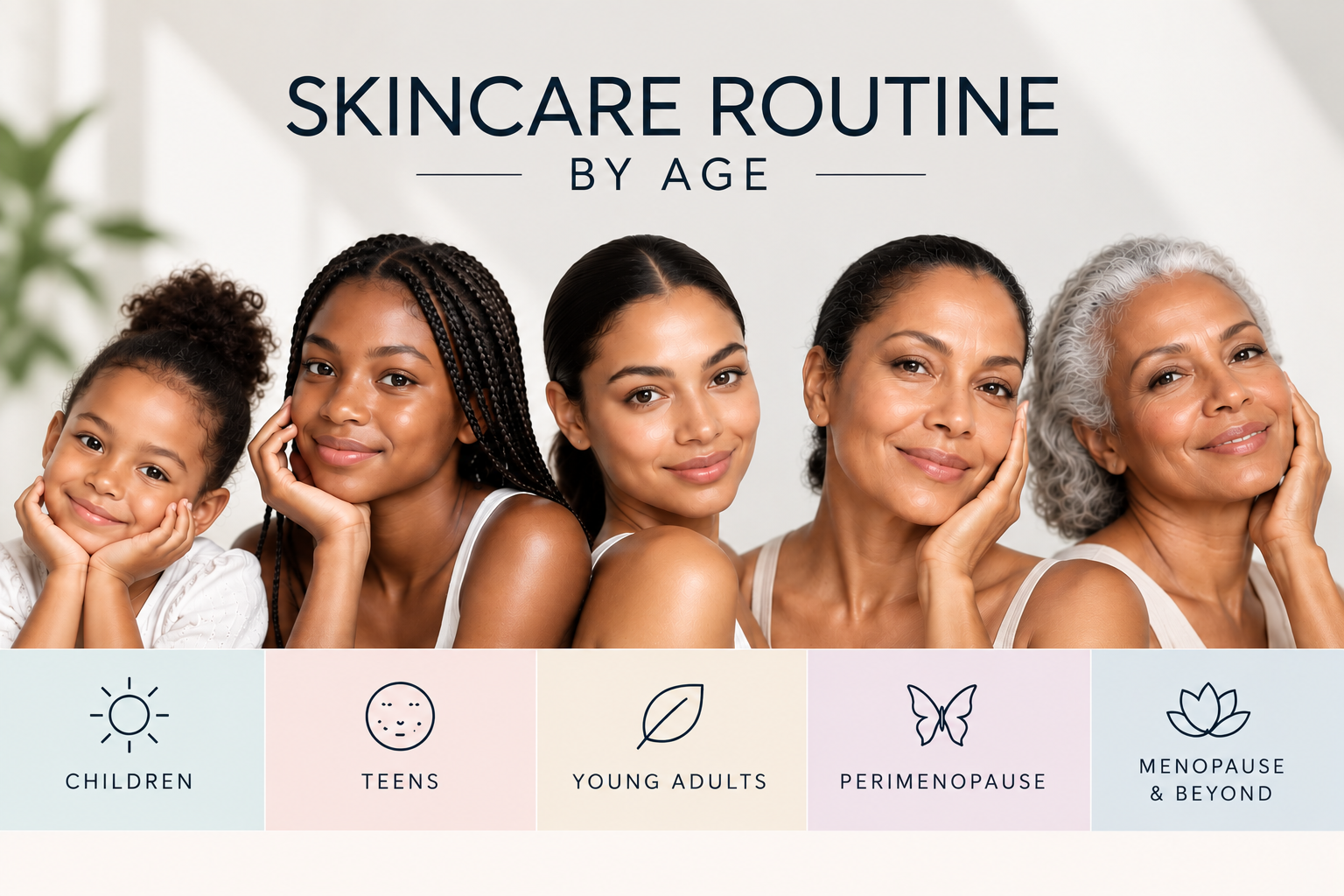
Here is a quick guide through five life stages.
1. Children: Keep It Simple and Protect Early
Children’s skincare should be simple, gentle and focused on protection.
A basic routine should include:
- Gentle cleansing
- Fragrance-free moisturiser
- Broad-spectrum sunscreen, together with hats, protective clothing and shade
Sun protection is particularly important from childhood. Establishing good photoprotection habits early helps reduce cumulative UV damage and can help lower the risk of premature skin ageing, pigmentation changes and skin cancer later in life.
Sunscreen should therefore not be thought of as something we introduce only when wrinkles become a concern. Healthy skin ageing starts with protection early in life.
Children generally do not need retinoids, exfoliating acids, peptides or anti-ageing serums unless a specific treatment has been recommended for a skin condition.
2. Teenagers: Build Good Habits and Treat What Is Present
Hormonal changes can increase oil production and acne during adolescence, but not every teenager has oily or acne-prone skin.
Keep the routine simple:
Gentle cleanser → Moisturiser → Sunscreen
If acne develops, ingredients such as benzoyl peroxide, salicylic acid or topical retinoids may be appropriate depending on the acne.
This stage should be about good skincare habits and treating actual skin problems, rather than copying complicated social-media routines.
Professional treatments should also be problem-led—for example, selected treatment for acne or acne scarring when appropriate.
3. Young Adults: Prevention and Targeted Treatment
In young adulthood, a skincare routine by age begins to place greater emphasis on preventing cumulative photodamage.
The foundation remains:
Cleanser → Moisturiser → Sunscreen
Depending on your skin and concerns, you may consider adding vitamin C or another antioxidant in the morning and a retinoid at night. Peptide-containing skincare can also be considered as an optional supportive addition.
Professional treatments may begin to feature when there is a specific concern such as acne scarring, pigmentation, uneven texture or early photoageing. Options may include selected chemical peels, microneedling or laser treatments.
Neuromodulators may be considered for established dynamic expression lines, but there is no particular age at which everyone needs to start injectables.
4. Perimenopause: Adapt as Your Skin Changes
During perimenopause, hormonal changes may be accompanied by increasing dryness, sensitivity and changes in elasticity and skin texture. Declining oestrogen is associated with changes in collagen, extracellular-matrix integrity and skin hydration.
At this stage, your skincare routine by age may need to adapt to increasing dryness or sensitivity. Prioritise barrier-supporting moisturisers, gentle cleansing and daily sunscreen, while adjusting retinoids and other active ingredients according to tolerance.
This is also a stage when more targeted healthy-ageing skincare may become useful. Peptides and selected regenerative skincare technologies, including growth-factor-containing formulations, can be considered for concerns such as fine lines, texture and overall skin quality.
They should be viewed as adjuncts rather than replacements for photoprotection, moisturisation or evidence-supported actives such as retinoids.
Professional options may include neuromodulators, dermal fillers, chemical peels, microneedling, radiofrequency microneedling and selected laser or energy-based treatments, depending on whether the concern is expression lines, volume changes, pigmentation, texture or laxity.
5. Menopause & Beyond: Barrier Support and Healthy Skin Ageing
After menopause, lower oestrogen levels are associated with changes in collagen, skin thickness, elasticity and hydration.
Your skincare routine by age can still remain straightforward:
Morning: Gentle cleanse → Antioxidant → Moisturiser → Sunscreen
Evening: Gentle cleanse → Retinoid if tolerated → Moisturiser
Richer moisturisers containing ingredients such as ceramides, glycerin, hyaluronic acid and other humectants and emollients may become particularly helpful.
Peptides and selected regenerative skincare, including growth-factor formulations, may also form part of a healthy-ageing routine. Evidence for topical growth factors suggests potential improvements in fine lines and skin texture, although results vary between technologies and products.
A combined approach may be appropriate when more visible ageing concerns are present. Neuromodulators can address dynamic expression lines, dermal fillers may address selected volume loss, while laser, chemical peels, microneedling and radiofrequency-based treatments can target different aspects of pigmentation, texture and photoageing.
Skincare remains the foundation; procedures address concerns that skincare alone cannot fully correct.
Dermatologist’s Perspective
A skincare routine by age is a guide—not a prescription.
A teenager with acne needs something different from a teenager with eczema. Similarly, two women going through menopause may have completely different skin needs.
My approach is simple: protect early, support the skin barrier, treat what is actually present and introduce advanced skincare or professional treatments according to concern rather than age.
Peptides and regenerative skincare can be useful additions, but newer does not automatically mean better. Sunscreen, moisturisation and appropriately selected evidence-based actives remain the foundation.
Find Skincare for Every Life Stage
From gentle cleansers and moisturisers to sunscreens, antioxidants, retinoids and targeted healthy-ageing skincare, explore dermatologist-selected products according to your skin type and concerns.
Shop Skincare at MD DermOutlet →
Explore Professional Skin & Aesthetic Treatments
Professional treatments can complement good skincare when concerns such as pigmentation, acne scarring, expression lines, volume loss or other features of photoageing require more targeted treatment.
Explore Professional Treatments →
Related Articles
Anti Aging Skincare Routine: 7 Essential Tips
A practical guide to sunscreen, retinoids, vitamin C, moisturisation and professional treatments for healthy skin ageing.
What Is My Skin Type? A Dermatologist’s Guide to Understanding Your Skin
Learn why skin type, current skin state and concerns such as acne, eczema or pigmentation are not the same thing.
How to Layer Skincare Products
Learn how to combine skincare products and active ingredients without unnecessarily complicating your routine.
References
- Quinlan DJ, Ghanem AM, Hassan H. Topical growth factor preparations for facial skin rejuvenation: A systematic review. Journal of Cosmetic Dermatology. 2023;22(7):2023–2039.
View on PubMed - Pivazyan L, et al. Skin Rejuvenation in Women using Menopausal Hormone Therapy: A Systematic Review and Meta-Analysis.
View on PubMed Central - Viscomi B, et al. Managing Menopausal Skin Changes: A Narrative Review of Skin Quality Changes, Their Aesthetic Impact, and the Actual Role of Hormone Replacement Therapy in Improvement. Journal of Cosmetic Dermatology. 2025.
Read the review
Like & Share