





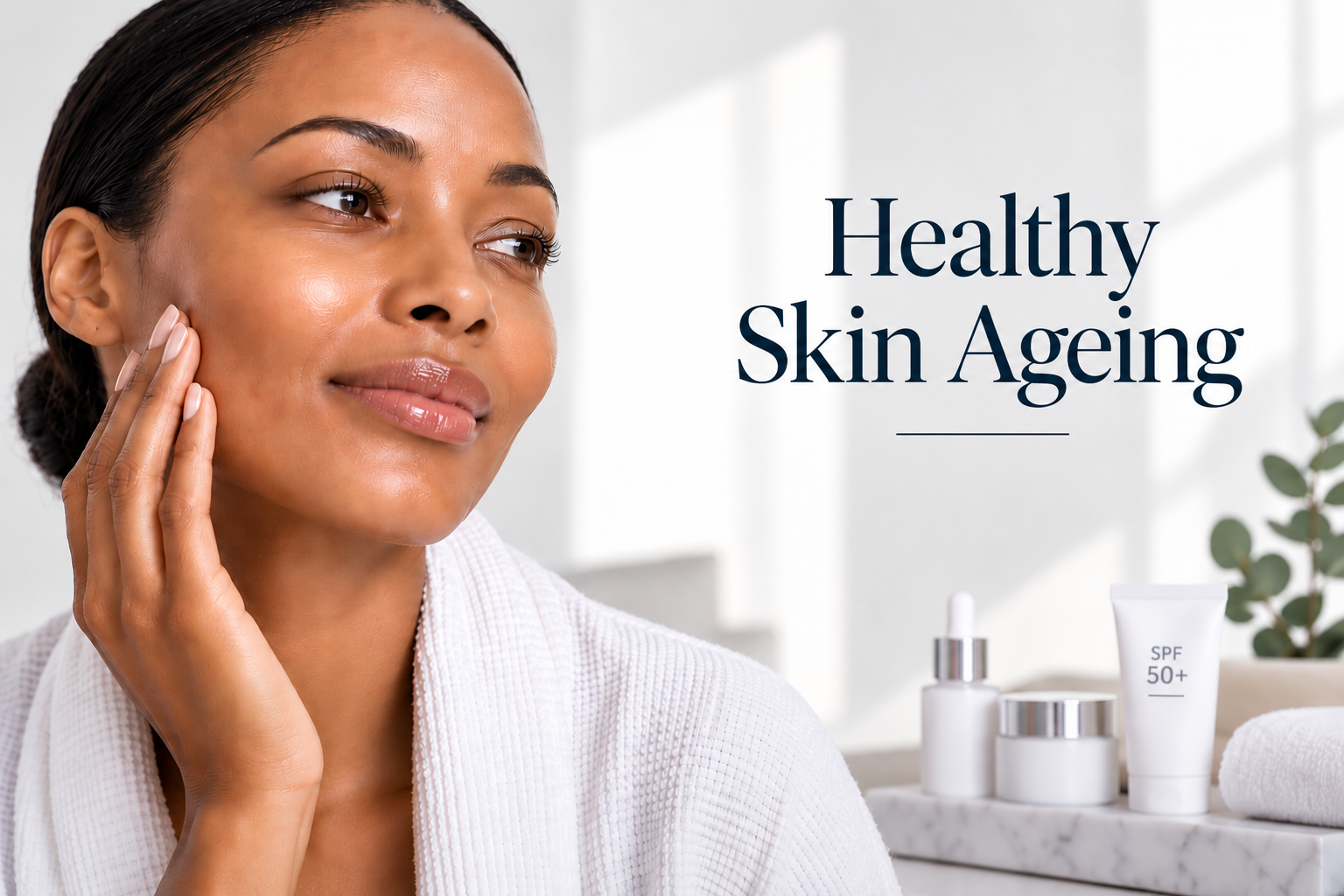
Anti Aging Skincare Routine: 7 Essential Tips
By Dr Matete Mathobela
Reviewed by Dr Matete Mathobela – Specialist Dermatologist
Founder of MD DermOutlet and MD Cosmeceuticals by Matete Derma
Read more about Dr Matete Mathobela →
Medical Disclaimer
This article is for educational purposes and does not replace individual medical advice. Skincare and professional treatments should be selected according to your skin type, concerns, medical history and individual tolerance.
Anti Aging Skincare Routine: Where Should You Start?
A good anti aging skincare routine does not need ten products. Start with evidence-supported essentials and add targeted treatments according to your skin’s needs.
In South Africa, daily photoprotection is particularly important when building a routine for healthy skin ageing. Fine lines and wrinkles develop through intrinsic ageing as well as external factors, particularly cumulative UV exposure.
Skincare cannot stop ageing, but the right routine can help reduce photoageing and improve hydration, texture, pigmentation and the appearance of fine lines.
1. Make Sunscreen Your Daily Essential
Broad-spectrum sunscreen is the foundation of an anti aging skincare routine.
UV exposure contributes to photoageing, including wrinkles, pigmentation changes and loss of elasticity.
Choose a broad-spectrum SPF 30 or higher, with SPF 50+ being a practical choice for high UV exposure, and apply it every morning.
2. Consider a Retinoid for Fine Lines
Retinoids have some of the strongest evidence among topical treatments for photoageing. Tretinoin has substantial clinical evidence for improving wrinkles, mottled pigmentation and other features of photodamaged skin.
Cosmetic retinoids such as retinol and retinaldehyde provide alternatives, although effectiveness and tolerability vary between formulations.
Introduce retinoids gradually and increase according to tolerance. Pairing them with an appropriate moisturiser can help support the skin barrier.
Retinoids are generally avoided during pregnancy.
3. Add Vitamin C in the Morning
Topical vitamin C is an antioxidant and can be a useful addition to an anti aging skincare routine, particularly when photoageing and uneven pigmentation are concerns. A systematic review found improvements in wrinkling and pigmentation, although more research is needed to establish optimal formulations and concentrations.
A simple morning routine could be:
Gentle cleanser → Vitamin C → Moisturiser → Sunscreen
Vitamin C complements sunscreen; it does not replace it.
4. What About Peptides and Regenerative Skincare?
Peptides are popular in anti-ageing skincare and may provide supportive benefits depending on the specific peptide, concentration and formulation. Evidence is not equally strong for every peptide or peptide-containing product.
Regenerative skincare is an expanding category that may include products designed to support skin repair, extracellular matrix signalling or recovery, depending on the technology used. However, “regenerative” is a broad marketing term rather than evidence that every product can regenerate ageing skin.
If your budget is limited, I would still prioritise sunscreen, an appropriate retinoid and moisturisation before investing heavily in multiple peptide or regenerative serums.
5. Support the Skin Barrier
A good anti aging skincare routine should also protect the skin barrier.
Skin often becomes drier with age, making moisturisation increasingly important. Look for ingredients such as ceramides, glycerin, hyaluronic acid, squalane and other humectants and emollients according to your skin’s needs.
Persistent burning, redness or excessive peeling does not mean your anti-ageing products are working better.
Healthy skin ageing is also influenced by factors beyond skincare, including smoking, UV exposure, sleep, nutrition and general health.
6. Keep Your Routine Simple
You do not need to layer multiple actives to have an effective routine.
Morning:
Cleanser → Antioxidant → Moisturiser → Sunscreen
Evening:
Cleanser → Retinoid or targeted treatment → Moisturiser
Additional products can then be selected according to concerns such as pigmentation, dryness, acne or sensitivity.
Skincare ranges from SkinCeuticals, NeoStrata, La Roche-Posay, Mesoestetic and other dermatologist-selected brands offer different options for antioxidants, retinoids, moisturisers and photoprotection.
7. When Should You Consider Neuromodulators, Fillers or Professional Treatments?
Even an excellent anti aging skincare routine cannot address every component of facial ageing.
Neuromodulators such as botulinum toxin type A temporarily reduce targeted muscle activity and can soften dynamic expression lines, particularly frown lines, forehead lines and crow’s feet.
Dermal fillers, most commonly hyaluronic acid fillers, may be used to address selected age-related volume loss and facial contour changes. Fillers do not replace skincare or neuromodulators; each addresses different components of facial ageing.
Other professional treatments such as chemical peels, microneedling, radiofrequency microneedling and selected laser or energy-based treatments may be considered for pigmentation, texture, photoageing and overall skin quality.
A simple way to understand the options is:
- Dynamic expression lines → neuromodulators may help
- Age-related volume loss or selected deeper folds → dermal fillers may be considered
- Pigmentation, texture and photoageing → selected peels, microneedling, laser or energy-based treatments may be appropriate
- Daily prevention and skin quality → skincare and photoprotection remain fundamental
The appropriate treatment—or combination of treatments—depends on what is causing the visible change. Treatment should also be individualised in darker skin tones, where unnecessary inflammation can increase the risk of post-inflammatory hyperpigmentation.
Professional treatments should complement rather than replace your home skincare routine.
Dermatologist’s Perspective
When building an anti aging skincare routine, I prioritise consistency over complexity.
Start with daily sunscreen and adequate moisturisation. If appropriate for your skin, introduce a retinoid gradually. Vitamin C can be a useful morning antioxidant, while peptides and other targeted ingredients can be added according to your concerns and budget.
For established expression lines, age-related volume loss or more advanced signs of photoageing, skincare can be combined with appropriately selected neuromodulators, dermal fillers and professional skin treatments.
Ultimately, the best anti aging skincare routine is one tailored to your skin, concerns, lifestyle and tolerance—not simply your age.
Shop Anti-Aging Skincare
Looking to build your routine? Explore dermatologist-selected retinoids, antioxidants, moisturisers, sunscreens and targeted skincare available from MD DermOutlet.
Shop Skincare at MD DermOutlet →
Explore Professional Skin & Aesthetic Treatments
Skincare forms the foundation of healthy skin ageing, while selected in-office treatments can address concerns that skincare alone cannot fully correct.
Explore Professional Treatments →
Related Articles
NeoStrata South Africa: A Dermatologist’s Guide
Learn how to choose between NeoStrata ranges for concerns including photoageing, pigmentation, texture and dryness.
How to Layer Skincare Products
Learn how to introduce and combine active ingredients without unnecessarily complicating your routine.
References
- Sitohang IBS, Makes WIM, Sandora N, Suryanegara J. Topical tretinoin for treating photoaging: A systematic review of randomized controlled trials. International Journal of Women’s Dermatology. 2022;8(1):e003.
View on PubMed - Siddiqui Z, et al. Comparing Tretinoin to Other Topical Therapies in the Treatment of Skin Photoaging: A Systematic Review. American Journal of Clinical Dermatology. 2024;25(6):873–890.
View on PubMed - Correia G, Magina S. Efficacy of topical vitamin C in melasma and photoaging: A systematic review. Journal of Cosmetic Dermatology. 2023;22(7):1938–1945.
View on PubMed - Rahman E, et al. Onabotulinum Toxin A for Upper Facial Expression Lines: A Systematic Review and Meta-Analysis. Aesthetic Surgery Journal. 2023;43(2):215–229.
View on PubMed - Elrosasy A, et al. Hyaluronic Acid Fillers for Cheek Volume Augmentation: A Systematic Review and Network Meta-Analysis. Archives of Dermatological Research. 2024;317(1):152.
View on PubMed - Foppiani JA, et al. Microneedling for Facial Rejuvenation: A Systematic Review. Aesthetic Plastic Surgery. 2025;49(17):4949–4960.
View on PubMed - Mar K, et al. Treatment of Post-Inflammatory Hyperpigmentation in Skin of Colour: A Systematic Review. Journal of Cutaneous Medicine and Surgery. 2024;28(5):473–480.
View on PubMed
Like & Share