



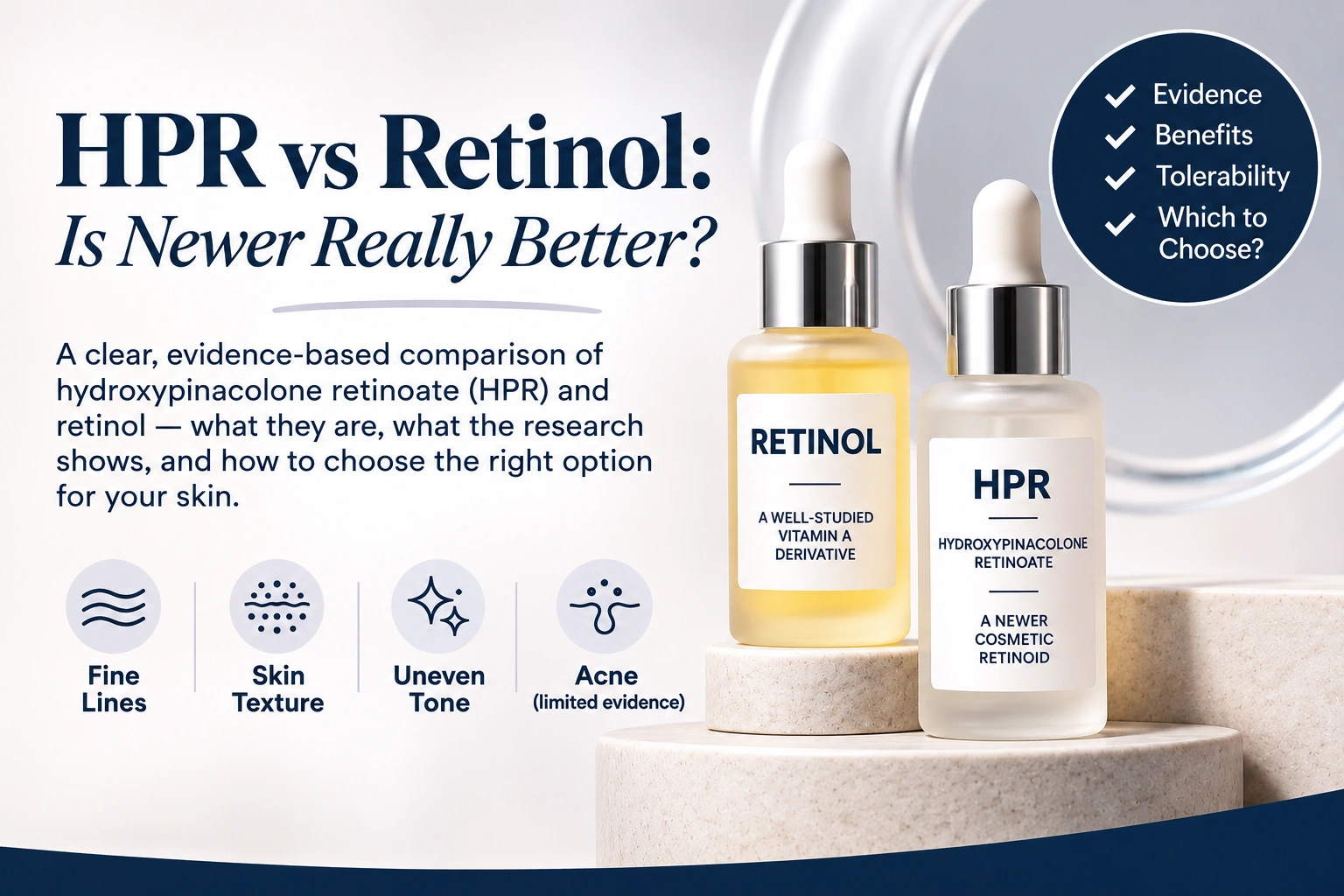
HPR vs retinol: Is hydroxypinacolone retinoate genuinely better than conventional retinol, or simply newer? Retinol has decades of research behind it, while emerging studies of certain HPR-related formulations are promising. The important questions are what each ingredient does, what has actually been tested in people, and which formula your skin can tolerate.
Reviewed by Dr Matete Mathobela – Specialist Dermatologist practising in Century City, Cape Gate Mediclinic and Life West Coast Private Hospital. Founder of MD Cosmeceuticals by Matete Derma and MD DermOutlet. Read more about Dr Matete Mathobela →
Medical Disclaimer: This guide provides general education, not personalised medical advice. Cosmetic retinoids may irritate the skin and are not suitable for everybody. Avoid retinoids during pregnancy and when planning pregnancy. Acne or persistent pigmentation may require assessment and prescription therapy.
In a Nutshell
- Retinol is a well-studied cosmetic vitamin A derivative used for features of photoageing.
- Hydroxypinacolone retinoate (HPR) is a retinoic acid ester with a different chemical structure and metabolic pathway.
- A small 2026 trial found promising results for a specific hydroxypinacolone 9-cis retinoate formulation, but it cannot be generalised to every HPR product.
- Laboratory work suggests retinol and HPR may affect collagen-related signalling together; clinical superiority of their combination over retinol alone has not been shown.
- In the HPR vs retinol decision, evidence, formulation, skin goals and tolerability are more useful than claims about conversion steps.
In This Guide
- 1. What Is the Difference Between HPR and Retinol?
- 2. HPR vs Retinol: Key Differences
- 3. What Does the Latest Research Say About HPR?
- 4. Can Combining HPR and Retinol Improve Results?
- 5. Is HPR Gentler Than Retinol?
- 6. Can HPR Help Acne and Hyperpigmentation?
- 7. Which Should You Choose: HPR or Retinol?
HPR vs Retinol: Is Newer Really Better?
Retinol has been used in anti-ageing skincare for decades, but newer cosmetic retinoids such as HPR are attracting attention. HPR is sometimes described as an advanced or gentler alternative. That sounds appealing, especially to people who experience peeling with retinol.
However, the HPR vs retinol comparison is more complex than simply counting chemical conversion steps. Concentration, delivery system, other formulation ingredients, study design and consistent use all affect outcomes.
1. What Is the Difference Between HPR and Retinol?
Both ingredients belong to the retinoid family, but they have different chemical structures. Retinol is a vitamin A alcohol that undergoes conversion in the skin:
Retinol → Retinaldehyde → Retinoic acid
Retinoic acid is the active metabolite responsible for many recognised effects of retinoids. HPR is a retinoic acid ester, so it does not follow the usual retinol-to-retinal conversion pathway.
Experimental research suggests retinoid receptor-related activity, but the exact behaviour and metabolism of HPR in human skin remain less thoroughly characterised than those of tretinoin. A cosmetic HPR product should not be equated with prescription tretinoin.
Dermatologist’s Perspective: Fewer conversion steps do not prove greater clinical effectiveness. The amount delivered, stability, other formulation ingredients and quality of the human evidence remain important.
2. HPR vs Retinol: Key Differences
Here is the evidence-based comparison at a glance. The table describes the ingredients generally, not any two specific finished products.
| Feature | Retinol | HPR |
|---|---|---|
| Ingredient type | Vitamin A alcohol | Retinoic acid ester |
| Conversion pathway | Retinol → retinaldehyde → retinoic acid | Does not follow the usual retinol-to-retinal conversion pathway |
| Photoageing evidence | Longer-established clinical research | Emerging formulation-specific clinical research |
| Potential cosmetic benefits | Fine lines, texture and uneven tone | Fine lines, texture and uneven tone |
| Irritation | Possible; depends on formulation and use | Possible; depends on formulation and use |
| Evidence for acne | Limited compared with prescription retinoids | Limited, often involving combination products |
| Clinical experience | Longer-established history | Still developing |
Neither ingredient guarantees freedom from irritation, and neither cosmetic ingredient has the established acne-treatment evidence of prescription adapalene or tretinoin.
3. What Does the Latest Research Say About HPR?
A 2026 study in the Journal of Investigative Dermatology examined hydroxypinacolone 9-cis retinoate, a particular retinoic acid ester, in laboratory and clinical research.
What did the human trial find?
In a four-week, single-blind, split-face study involving 31 Chinese women, researchers compared daily use of 0.03% 9-cis HPR with 0.3% retinol. Both sides showed improvements in several photoageing measures, including wrinkles, elasticity, hydration and skin radiance. Some results favoured the tested 9-cis formulation, while others were comparable, and no irritation was observed with 9-cis HPR during this short trial.
Does that prove HPR is better than retinol?
Not yet. This was a small four-week study of one specific formulation in a limited population. Its results should not be used as proof that every consumer product labelled HPR is stronger or better tolerated than retinol. The tenfold difference in concentrations does not establish a universal tenfold difference in potency.
Research interpretation: The product marketed as hydroxypinacolone retinoate in a skincare cream is not necessarily the identical 9-cis preparation evaluated in the study. Results from one molecular form or finished formulation cannot automatically be transferred to another.
4. Can Combining HPR and Retinol Improve Results?
Researchers are also investigating whether combining cosmetic retinoids can improve biological signalling involved in skin ageing. A 2026 Journal of Cosmetic Dermatology study explored a serum combining retinol, HPR, peptides and silybin.
Laboratory tests showed that retinol and HPR together enhanced certain collagen-related pathways compared with retinol alone. The researchers also assessed a multi-ingredient serum in 31 women over eight weeks and reported improvements in wrinkles, elasticity, hydration and other photoageing features.
Important limitation: The human study was open-label and did not include a retinol-only comparator. It therefore cannot show that adding HPR to retinol caused the clinical improvements, or that the combination is clinically superior to retinol alone. The serum also contained additional active ingredients.
Dermatologist’s Perspective: A carefully formulated combination may be interesting. That does not mean applying two separate retinoid products on top of one another is better. Unsupervised layering may increase irritation without a proven additional benefit.
5. Is HPR Gentler Than Retinol?
HPR is often promoted as a more comfortable retinoid. Some early research suggests good tolerability with specific formulations, but HPR vs retinol tolerability cannot be ranked universally. Concentration, formulation, frequency and each person’s skin barrier all matter.
Either ingredient can cause dryness, redness, flaking or retinoid dermatitis. In skin of colour, limiting unnecessary inflammation is particularly important because it can contribute to post-inflammatory hyperpigmentation.
Visible peeling is not required for a retinoid to work. If a product consistently burns, stings or causes significant dermatitis, reassess how it is used rather than increasing the strength.
Related: Why Healthy Skin Starts with Your Skin Barrier.
6. Can HPR Help Acne and Hyperpigmentation?
HPR-containing combinations have been studied for acne. In a pilot open-label study of mild-to-moderate acne, investigators evaluated a preparation containing HPR, encapsulated retinol and papain. Acne scores improved, but because several ingredients were used together, the study could not establish how much HPR contributed independently.
Prescription topical retinoids such as adapalene and tretinoin have a much stronger clinical foundation for treating acne. Cosmetic HPR products are not substitutes for prescription treatment when indicated.
HPR-containing cosmetic formulations may improve uneven-looking skin tone and photoageing-associated pigmentation. Melasma or persistent acne-related dark marks, however, may require more specific care and appropriate photoprotection.
For deeper explanations, read Pigmentation in Skin of Colour and 7 Effective Hyperpigmentation Treatments in South Africa.
7. Which Should You Choose: HPR or Retinol?
Consider retinol if: You prefer a cosmetic retinoid with a longer record of clinical research for photoageing and fine lines, and find a suitable formulation you can tolerate.
Consider HPR if: You are interested in an emerging cosmetic retinoid and have found a formulation supported by appropriate evidence for your goals.
Consider prescription treatment if: You have persistent acne, clinically significant pigmentation or another skin disorder needing an established medical treatment.
In the HPR vs retinol choice, the most important question is not which name sounds newer. It is which finished formulation is appropriate for your skin, has credible evidence and can be used consistently.
Interested in an HPR-Containing Retinoid?
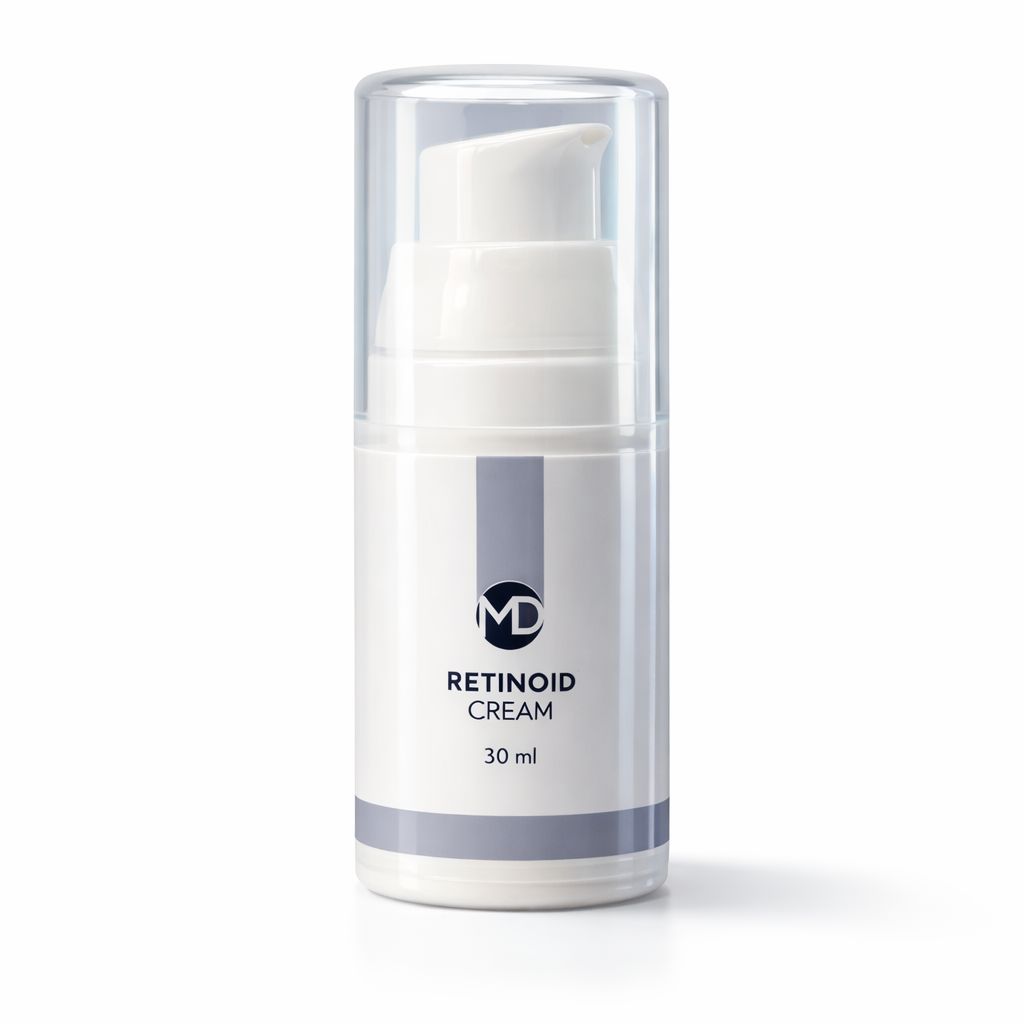
MD Cosmeceuticals Retinoid Cream by Matete Derma contains HPR together with bakuchiol, niacinamide and other supporting ingredients. It is designed as cosmetic skincare for the appearance of uneven skin tone, texture and signs of ageing, while incorporating hydrating ingredients.
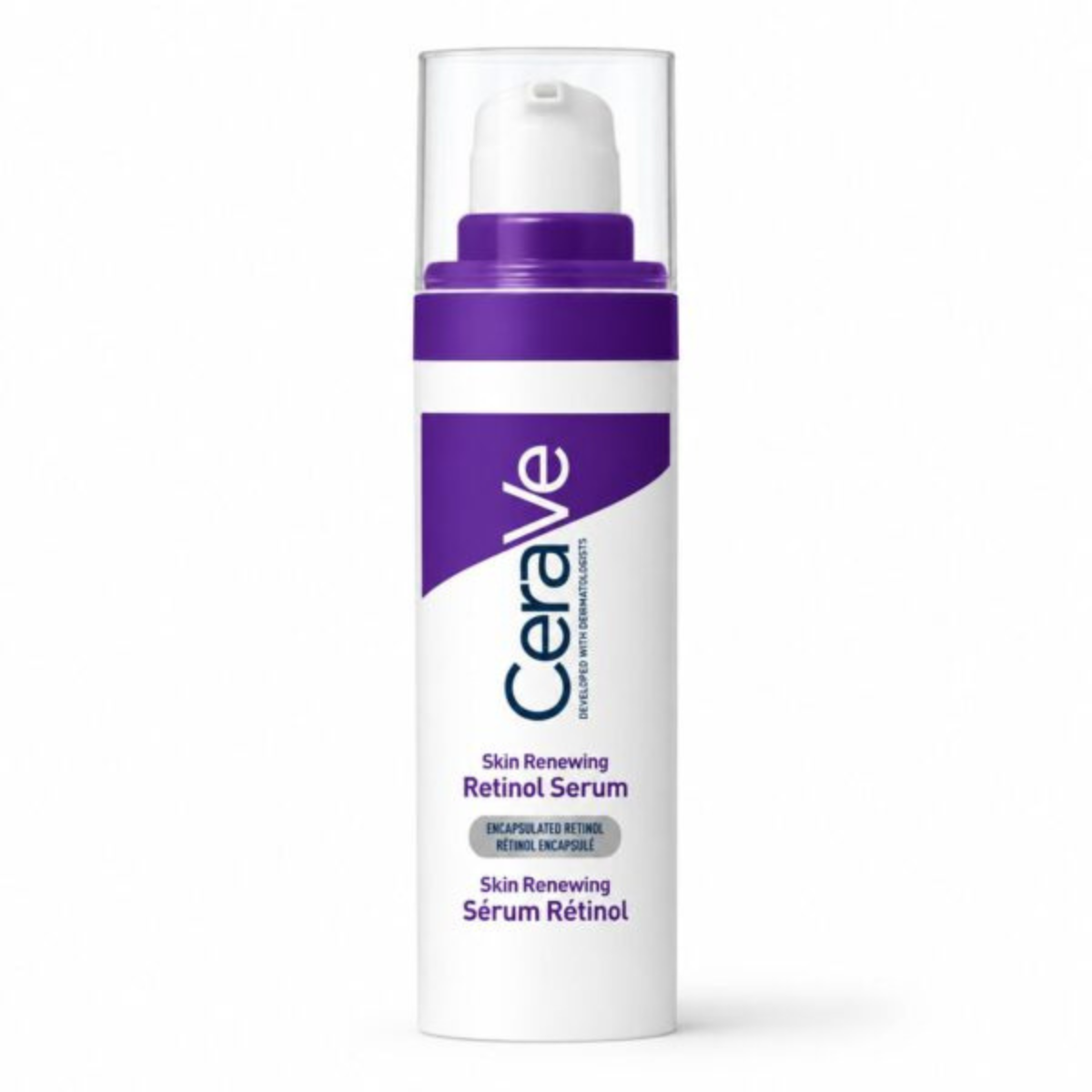
For a HPR vs retinol shopping comparison, the two products below are genuine items available through MD DermOutlet. They are examples of products containing these respective ingredients, not products tested against one another in the cited studies.
Learn more about the MD Retinoid Cream formulation → or where to buy dermatologist-recommended skincare →.
Clinical caution: Research on other HPR formulations does not establish the clinical performance of MD Cosmeceuticals Retinoid Cream itself. Avoid retinoids during pregnancy and when planning pregnancy.
Frequently Asked Questions
Is HPR stronger than retinol?
Not necessarily. Results from individual experimental formulas are promising but do not establish a universal potency ranking for all HPR and retinol products.
Does HPR work without conversion?
HPR does not follow the usual retinol → retinal → retinoic acid conversion route. That does not mean its biological activity or metabolism is identical to tretinoin.
Is HPR the same as tretinoin?
No. HPR is a retinoic acid ester used in cosmetic skincare; tretinoin is retinoic acid itself and has a much more established clinical evidence base.
Can HPR and retinol be combined?
Selected multi-ingredient formulas have been studied, but layering separate retinoid products is generally unnecessary and can increase irritation.
Is HPR suitable for sensitive skin?
Some HPR formulations may be well tolerated, although irritation remains possible. Product choice and gradual introduction are important.
Can I use HPR during pregnancy?
Retinoid-containing products, including HPR formulas, should be avoided during pregnancy and when planning pregnancy.
Final Thoughts
The HPR vs retinol comparison illustrates how cosmetic retinoid science is evolving. Retinol has a long history of photoageing research; emerging HPR-related evidence is promising for wrinkles, elasticity and skin radiance.
However, encouraging short-term results and laboratory findings should not be interpreted as proof that HPR is universally superior or that separate retinoid products should be layered. A suitable treatment supports the skin without creating unnecessary inflammation.
Dermatologist’s Perspective: I prioritise realistic expectations, the strength of the evidence, and skin tolerance. If you have persistent acne, troublesome pigmentation or significant irritation, consult Dr Matete Mathobela for an individualised assessment →.
Suggested Reading
- MD Retinoid Cream: How This Advanced Retinoid Works
- Bakuchiol vs Retinol: Is the Natural Alternative as Effective?
- Why Healthy Skin Starts with Your Skin Barrier
- Pigmentation in Skin of Colour: Why Dark Marks Last Longer
- Retinol for Anti-Aging: A Guide to Youthful Skin
Scientific References
- Hu F, et al. Hydroxypinacolone 9-cis Retinoate Mitigates UV-Induced Photoaging by Modulating Extracellular Matrix, Fibroblasts, Inflammation, and Melanogenesis. J Invest Dermatol. 2026. Read the study →
- Shen Y, et al. An Innovative Serum With Retinol, Hydroxypinacolone Retinoate, Peptides, and Silybin Improves Mild Photoaged Facial Skin in Middle-Aged Chinese Women. J Cosmet Dermatol. 2026;25(1):e70627. Read the study →
- Treatment of Mild to Moderate Acne With a Fixed Combination of Hydroxypinacolone Retinoate, Retinol Glycospheres and Papain Glycospheres. Read the clinical study →
- Mukherjee S, et al. Retinoids in the Treatment of Skin Aging: An Overview of Clinical Efficacy and Safety. Clin Interv Aging. 2006;1(4):327–348. Read the review →