



Bakuchiol vs retinol is a comparison worth understanding if you want to improve fine lines, uneven skin tone or early signs of photoageing but find conventional retinol irritating. Bakuchiol is a plant-derived cosmetic ingredient, whereas retinol belongs to the vitamin A family. They may have some overlapping benefits, but their chemistry and strength of clinical evidence differ.
Reviewed by Dr Matete Mathobela – Specialist Dermatologist practising in Century City, Cape Gate Mediclinic and Life West Coast Private Hospital. Founder of MD Cosmeceuticals by Matete Derma and MD DermOutlet.
Read more about Dr Matete Mathobela →
Medical disclaimer: This article is for educational purposes and does not replace personalised medical advice. Bakuchiol may cause irritation or allergic reactions. Its safety during pregnancy and breastfeeding has not been adequately established. Prescription retinoids should be used under appropriate medical guidance.
In a Nutshell
- Bakuchiol is a plant-derived compound with some retinol-like cosmetic effects, but it is not a retinoid.
- Retinol is a vitamin A derivative with a longer history of research for photoageing.
- A small clinical trial found improvements in wrinkles and pigmentation with both ingredients.
- Bakuchiol caused fewer irritation complaints in that trial, but this does not establish equivalence to prescription tretinoin.
- Natural does not automatically mean safe during pregnancy.
On This Page
- Bakuchiol vs retinol: what is different?
- Key differences table
- What does the clinical evidence show?
- Sensitive skin and irritation
- Pregnancy considerations
- A relevant MD DermOutlet product
- Frequently asked questions
Bakuchiol vs Retinol: What’s the Difference?
Bakuchiol is associated with the babchi plant (Psoralea corylifolia). Although it can influence some skin-ageing pathways in experimental studies, bakuchiol is not a vitamin A derivative and does not convert into retinoic acid in the skin. It is better described as a potential functional alternative to cosmetic retinol, rather than a true retinoid.
Retinol, by contrast, undergoes conversion through retinaldehyde to retinoic acid, which acts on retinoid receptors. Its effects depend on concentration, formulation and individual skin tolerance.
Bakuchiol vs Retinol: Key Differences
The bakuchiol vs retinol comparison table summarises the differences in ingredient type, evidence and tolerability.
On mobile, swipe sideways to read the entire table.
| Feature | Bakuchiol | Retinol |
|---|---|---|
| Ingredient type | Plant-derived compound | Vitamin A derivative |
| Is it a retinoid? | No | Yes |
| Converts to retinoic acid? | No | Yes |
| Evidence for wrinkles | Preliminary clinical evidence | More established research |
| Pigmentation | Promising early results | Evidence from selected formulations |
| Irritation | Possible; well tolerated in small studies | Dryness, peeling and stinging may occur |
| Pregnancy | Insufficient human safety data | Avoid during pregnancy |
Bakuchiol vs Retinol: What Does the Clinical Research Show?
A randomised, double-blind 2019 bakuchiol vs retinol study compared 0.5% bakuchiol twice daily with 0.5% retinol once daily in 44 participants over 12 weeks. Both groups showed improvements in wrinkle surface area and photoageing-related hyperpigmentation, with no statistically significant between-group difference for the measured outcomes. Retinol users reported more scaling and stinging.
Does that mean bakuchiol works just as well?
Not necessarily. The study was small and short, with unequal dosing frequencies. It did not compare bakuchiol to prescription tretinoin or establish results for every formulation. One encouraging trial should not be treated as evidence that bakuchiol can replace established retinoid treatments.
Read the original 2019 clinical study →
Bakuchiol vs Retinol: Which Is Gentler on Sensitive Skin?
Possibly for some patients. In the 2019 study, participants using bakuchiol reported fewer irritation-related symptoms. This may make it worth discussing if conventional cosmetic retinol causes dryness or stinging.
However, plant-derived ingredients can still trigger irritation or allergic contact dermatitis. Anyone with eczema, rosacea or reactive skin should introduce new products carefully. If you prefer to continue using a retinoid, a suitable moisturiser and gradual introduction may improve tolerance.
Can Bakuchiol Treat Acne or Hyperpigmentation?
Experimental studies have reported anti-inflammatory and other potentially useful effects of bakuchiol, but clinical evidence for acne treatment remains limited. It should not replace medically indicated treatments such as adapalene or tretinoin.
The bakuchiol vs retinol trial also reported improvements in photoageing-related pigmentation. That does not establish bakuchiol as an effective standalone treatment for melasma or persistent post-inflammatory hyperpigmentation.
Is Bakuchiol Safe During Pregnancy?
In bakuchiol vs retinol discussions, bakuchiol is sometimes promoted as a pregnancy-safe alternative because it is plant-derived and not a retinoid. However, there is insufficient human pregnancy and breastfeeding safety information to confirm that claim.
People who are pregnant, breastfeeding or planning pregnancy should discuss suitable skincare ingredients with their healthcare professional. Natural ingredients are not automatically risk-free.
Can Bakuchiol and Retinoids Be Used Together?
Yes. Some cosmetic formulations combine bakuchiol with retinoids, but the combination has not been shown to be universally more effective than either ingredient alone. Results depend on the full formulation and evidence for that finished product. Using more actives does not necessarily produce faster results, especially if the skin becomes irritated.
Interested in Skincare Containing Bakuchiol?
MD Cosmeceuticals Retinoid Cream by Matete Derma combines bakuchiol with hydroxypinacolone retinoate (HPR) and niacinamide in a hydrating cream. It is formulated for the appearance of fine lines, uneven tone and skin texture.
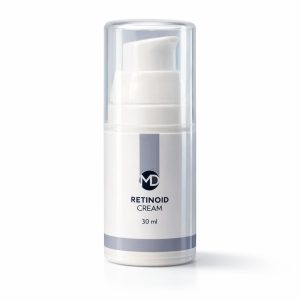
Please note: This product contains a cosmetic retinoid and is not a bakuchiol-only treatment. The bakuchiol/retinol comparative study did not investigate this formulation. Avoid use during pregnancy or while planning pregnancy.
Dermatologist’s Perspective
When evaluating bakuchiol vs retinol, consider your skin concern, the evidence for the specific formulation and how well your skin tolerates it. Retinol has a longer clinical evidence base, while bakuchiol is a promising cosmetic ingredient for some people who cannot tolerate conventional retinol. Neither should be chosen simply because it is marketed as natural, new or stronger.
Frequently Asked Questions
Is bakuchiol the same as retinol?
No. Bakuchiol is structurally unrelated to vitamin A and does not follow the usual retinoid conversion pathway.
Is bakuchiol better than retinol for wrinkles?
One small study found improvements with both ingredients, but larger and longer comparisons are needed.
Does bakuchiol cause purging?
Bakuchiol is not a retinoid, and a predictable retinoid-type purging response has not been established. New breakouts should not automatically be dismissed as purging.
Can bakuchiol cause irritation?
Yes. Irritation and allergic contact dermatitis are possible even with plant-derived ingredients.
Can bakuchiol replace prescription tretinoin?
No. It does not have equivalent clinical evidence for acne or photoageing and should not replace medically indicated treatment.
Can I use bakuchiol while pregnant?
Human pregnancy safety evidence is insufficient; discuss alternatives with your healthcare professional.
Final Thoughts
The bakuchiol vs retinol comparison highlights an interesting development in cosmetic skincare. Bakuchiol may improve some visible signs of photoageing and could be an option for patients who struggle to tolerate cosmetic retinol. It is not a proven replacement for prescription retinoids.
Related Reading
Learn more about a dermatologist consultation with Dr Matete Mathobela →
Scientific References
- Dhaliwal S, et al. (2019). Prospective, Randomized, Double-Blind Assessment of Topical Bakuchiol and Retinol for Facial Photoageing. British Journal of Dermatology. Original clinical trial →
- Chaudhuri RK, Bojanowski K. (2014). Bakuchiol: A Retinol-Like Functional Compound Revealed by Gene Expression Profiling and Clinically Proven to Have Anti-Aging Effects. International Journal of Cosmetic Science. Original research →
- The Use of Bakuchiol in Dermatology: A Review of In Vitro and In Vivo Evidence. (2022). Journal of Drugs in Dermatology. Read the review →
- Mukherjee S, et al. (2006). Retinoids in the Treatment of Skin Aging: An Overview of Clinical Efficacy and Safety. Clinical Interventions in Aging. Read the review →