



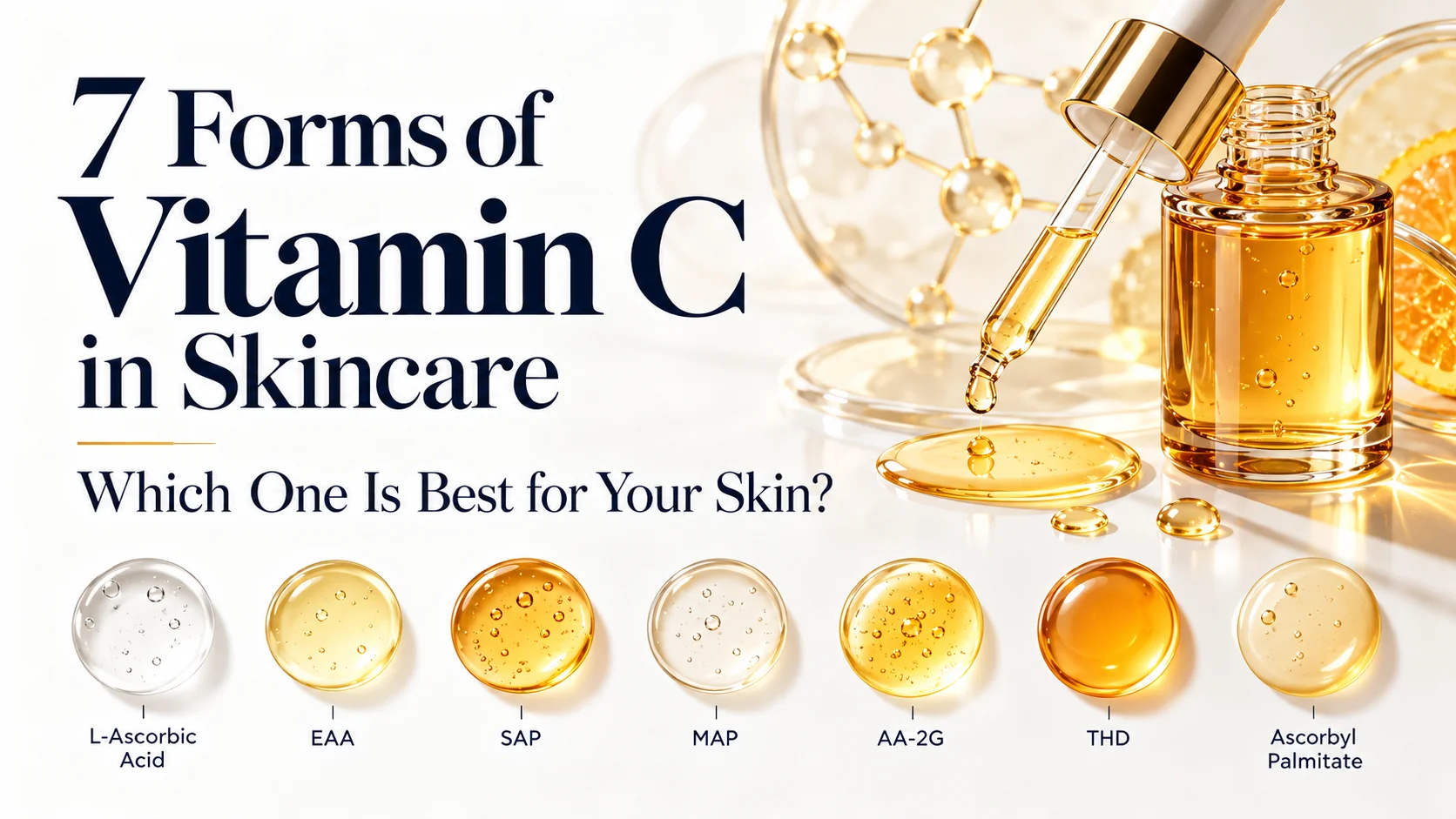
Forms of vitamin C in skincare vary in stability, solubility and clinical evidence. This guide compares seven forms and how to choose an appropriate formulation.
Reviewed by Dr Matete Mathobela – Specialist Dermatologist. Read more about Dr Matete Mathobela →
Medical disclaimer: This article provides general skincare education and does not replace personalised medical advice. Product selection and treatment should be individualised, particularly for sensitive skin, melasma and other persistent skin conditions. Consult a qualified healthcare professional for advice specific to your skin.
On This Page
- Why Is Vitamin C Important for Your Skin?
- Comparing the 7 Forms of Vitamin C in Skincare
- How Do You Choose the Right Vitamin C?
- Vitamin C, Inflammation and Hyperpigmentation
- How to Use Vitamin C in Your Skincare Routine
- Frequently Asked Questions
In a Nutshell
Vitamin C is one of the most versatile ingredients in skincare. It provides antioxidant protection, supports collagen production and helps improve the appearance of uneven skin tone, fine lines and early signs of ageing.
But not every vitamin C serum contains the same form of vitamin C.
The different forms of vitamin C in skincare vary in stability, solubility and formulation characteristics. Some are found in lightweight serums, while others are incorporated into nourishing creams or oil-based products.
Many share similar skincare goals. The important differences are how they are formulated, how well they are tolerated and the clinical evidence supporting particular outcomes.
The best vitamin C product is not necessarily the one with the highest percentage. It is the one that suits your skin concerns and works consistently within your skincare routine.
Why Is Vitamin C Important for Your Skin?
Antioxidant Protection
Ultraviolet radiation, pollution and other environmental factors generate free radicals that contribute to oxidative stress and premature skin ageing.
Vitamin C helps protect against oxidative damage by supporting the skin’s antioxidant defences. It complements sunscreen but does not replace it.
Collagen Support and Fine Lines
Vitamin C plays an essential role in normal collagen synthesis, helping maintain the skin’s structure and firmness.
Topical vitamin C is commonly used to address fine lines, uneven texture and visible signs of photoageing. Several vitamin C derivatives also support collagen-related processes, although the amount of clinical evidence differs between formulations.
Brighter, More Even-Looking Skin
Vitamin C is widely used in skincare for dullness, dark marks and uneven pigmentation.
It can influence pathways involved in melanin production and complement treatments for post-inflammatory hyperpigmentation and melasma.
Support Against Environmental Stress
Oxidative stress and inflammation are closely connected to premature skin ageing and certain pigmentation concerns.
Vitamin C and its derivatives are incorporated into skincare designed to help protect against these environmental effects.
Why Are There Different Forms of Vitamin C?
Pure vitamin C is called L-ascorbic acid. It is biologically active and has the most extensive clinical research among topical vitamin C ingredients.
However, L-ascorbic acid is sensitive to light, heat and oxygen. It also commonly requires an acidic formulation, which some people may find irritating.
Vitamin C derivatives offer alternative ways to formulate antioxidant skincare.
Some are water-soluble, others are lipid-soluble, and some can be incorporated into specialised delivery systems.
These differences allow vitamin C products to offer a variety of textures, stability characteristics and skin-feel preferences.
Comparing the 7 Forms of Vitamin C in Skincare
What Benefits Do These Forms Share?
Vitamin C and its derivatives are used in skincare to provide antioxidant protection, support brighter and more even-looking skin, and help address fine lines and early signs of ageing.
Vitamin C is essential for collagen synthesis, and several derivatives contribute to collagen-related processes.
These benefits are not exclusive to L-ascorbic acid. However, the strength of evidence for particular clinical outcomes differs between ingredients and finished products.
The table below focuses on what distinguishes the seven forms.
On a mobile device, swipe across the table to see every column.
| Vitamin C form | Key characteristics | Formulation characteristics | Common skin types and preferences | Product examples |
|---|---|---|---|---|
| 1. L-Ascorbic Acid (L-AA) | Pure, biologically active vitamin C with the strongest topical clinical evidence. | Often used in acidic, water-based antioxidant serums or specialised suspensions. | Normal, oily, combination and mature skin; sensitive skin when tolerated. | SkinCeuticals C E Ferulic, Phloretin CF and Silymarin CF; Obagi Professional-C; NeoStrata Enlighten 15% Vitamin C + PHA Serum; CeraVe Skin Renewing Vitamin C Serum 10%; Endocare Radiance C Ferulic Serum Gel; mesoestetic aox ferulic; iS Clinical Super Serum Advance+ and Pro-Heal Serum Advance+; Lamelle Recharge CE; Lamelle Correctives Vita C 30; Institut Esthederm Intensive Vitamin C² Dual Concentrate |
| 2. Tetrahexyldecyl Ascorbate (THD) / Ascorbyl Tetraisopalmitate | Lipid-soluble vitamin C ingredients used in antioxidant and anti-ageing skincare. | Suitable for oil-based serums, emulsions and nourishing creams. | Dry, mature and dehydrated skin; people who prefer richer textures. | MD Cosmeceuticals Jojoba Vitamin C Serum; MD Cosmeceuticals Brightening Cream – Advanced Hydration; Lamelle Correctives Vita-C Lipid Serum |
| 3. 3-O-Ethyl Ascorbic Acid (EAA) | Stabilised vitamin C derivative with versatile formulation properties. | Used in gels, serums and creams. | Normal, oily and combination skin; people who prefer lightweight textures. | MD Cosmeceuticals Vitamin C + Glutathione Gel Serum |
| 4. Sodium Ascorbyl Phosphate (SAP) | Stable, water-soluble vitamin C derivative also used in blemish-focused formulations. | Compatible with less acidic formulations. | Oily, acne-prone, combination and sensitive skin, depending on the product. | MD Cosmeceuticals Melanclear Serum; Lamelle RFM Serum |
| 5. Magnesium Ascorbyl Phosphate (MAP) | Stable vitamin C derivative used in antioxidant, brightening and anti-ageing formulations. | Water-soluble and suitable for less acidic products. | Sensitive, dry and mature skin, depending on the formulation. | — |
| 6. Ascorbyl Glucoside (Vitamin Cg) | Stable vitamin C derivative commonly used in brightening and antioxidant skincare. | Often incorporated into water-based serums and creams. | Normal, combination, mature and sensitive skin. | Avène Vitamin Activ Cg Radiance Corrector Serum; Institut Esthederm Intensive Vitamin C² Dual Concentrate |
| 7. Trisodium Ascorbyl 2-Phosphate 6-Palmitate (APPS) | Amphiphilic vitamin C derivative with specialised skin-delivery characteristics. | Used in formulations incorporating both water- and lipid-compatible properties. | Different skin types, depending on the finished formulation. | — |
Product examples illustrate the different vitamin C ingredients and do not represent a ranking of effectiveness. Some products contain more than one form of vitamin C. Formulations may change, so refer to the ingredient list on the product packaging.
Product examples in the comparison table are reproduced from the source article; formulations and ingredient lists should be checked before publication.
How Do You Choose the Right Vitamin C?
Start with your skin concerns and the type of formulation you prefer.
If you enjoy lightweight products, a gel or fluid serum may be a practical choice. If your skin is dry, a richer vitamin C cream or oil-based serum may be more comfortable.
For sensitive skin, tolerability is particularly important. A less acidic derivative-based formulation may be preferable, although the entire ingredient list matters.
For pigmentation, fine lines and sun-related ageing, vitamin C can be a valuable addition to a consistent routine.
The formulation, not the ingredient name alone, determines whether a vitamin C product is a good choice for your skin.
Does Vitamin C Need to Be Converted to Work?
L-ascorbic acid is already biologically active.
Some vitamin C derivatives, including Sodium Ascorbyl Phosphate, Magnesium Ascorbyl Phosphate and Ascorbyl Glucoside, can release L-ascorbic acid through processes within the skin.
Other derivatives also demonstrate antioxidant activity.
These differences are relevant to formulation science, but patients do not need to choose a product based on conversion alone.
Vitamin C, Inflammation and Hyperpigmentation
Vitamin C is often discussed as a brightening ingredient, but pigmentation is not simply a matter of producing too much melanin.
Oxidative stress and inflammation can contribute to the development and persistence of dark marks.
This is particularly relevant to post-inflammatory hyperpigmentation and melasma.
Why Is Melasma More Than Excess Melanin?
Melasma is a complex condition associated with:
- Increased melanin production.
- Chronic inflammation and oxidative stress.
- Changes in superficial blood vessels.
- Basement membrane damage.
- Altered activity of dermal fibroblasts.
These processes help explain why melasma can persist or recur despite treatment.
Vitamin C can provide useful antioxidant and pigmentation-related support, but it should not be viewed as a complete treatment for melasma.
Effective management usually involves careful photoprotection and, where appropriate, dermatologist-guided treatment.
For melasma, daily broad-spectrum sunscreen is essential. Tinted sunscreens containing iron oxides can offer additional protection against visible light.
For more information, read our hyperpigmentation guide.
Is a Higher Vitamin C Percentage Always Better?
No.
A product containing 20% L-ascorbic acid cannot be directly compared with one containing 20% of a different derivative.
Concentration is only one factor.
Stability, packaging, delivery, supporting ingredients and skin tolerance all influence how a product performs.
A lower-concentration product with a suitable formulation may be a better choice than a stronger product that repeatedly causes irritation.
How to Use Vitamin C in Your Skincare Routine
A simple morning routine is often sufficient:
- Cleanse: Use a gentle cleanser.
- Apply vitamin C: Follow the product instructions.
- Moisturise: Apply a moisturiser suited to your skin.
- Protect: Finish with broad-spectrum sunscreen, preferably SPF 30 or higher.
Some vitamin C products can also be used in the evening.
Can Vitamin C Be Combined With Other Active Ingredients?
Niacinamide: Generally compatible with vitamin C.
Retinoids: Can be used in the same overall routine, provided your skin tolerates the combination. Many people use vitamin C in the morning and retinoids at night.
Azelaic acid: Can complement vitamin C in routines targeting uneven pigmentation.
Introduce active ingredients gradually rather than starting several new products simultaneously.
After chemical peels, laser or microneedling treatments, follow your treating clinician’s aftercare instructions before restarting vitamin C.
For more guidance, read our anti-ageing skincare routine guide.
Common Vitamin C Myths
Myth: Only pure L-ascorbic acid provides anti-ageing benefits.
Vitamin C derivatives are also used in antioxidant and anti-ageing skincare, although the strength of supporting clinical evidence varies.
Myth: Higher vitamin C percentages always give better results.
The complete formulation and skin tolerance matter more than percentage alone.
Myth: Oil-soluble vitamin C is automatically more effective.
Solubility influences how an ingredient is formulated; it does not independently establish superior clinical results.
Myth: Vitamin C can replace sunscreen.
Vitamin C complements daily photoprotection but does not replace sunscreen.
Myth: Vitamin C alone can clear melasma.
Melasma usually requires a broader management approach.
Frequently Asked Questions
Which form of vitamin C is best for skin?
There is no single best form for everyone. L-ascorbic acid has the most extensive clinical evidence, while derivatives provide different formulation and tolerability options.
Do vitamin C derivatives help with fine lines?
Vitamin C derivatives are used in skincare targeting fine lines and early signs of ageing. The degree of improvement depends on the ingredient, concentration and finished formulation.
Which vitamin C is best for sensitive skin?
Less acidic formulations may be more comfortable, but sensitivity depends on the complete product. Introduce new products gradually.
Is vitamin C good for pigmentation?
Vitamin C can help improve uneven-looking skin tone and complement a pigmentation-focused skincare routine. Persistent pigmentation may require additional treatment.
Can I use vitamin C with retinol?
Yes, if tolerated. Using vitamin C in the morning and retinol at night is a practical approach for many people.
How long does vitamin C take to show results?
Changes in radiance may become noticeable within several weeks, while improvements in pigmentation and fine lines generally require longer, consistent use.
The Dermatologist’s Perspective
The variety of vitamin C ingredients available today gives patients more choice.
L-ascorbic acid remains the most extensively researched topical form, but it is not the only ingredient used for antioxidant protection, brighter-looking skin or care targeting early signs of ageing.
Vitamin C derivatives allow manufacturers to develop different textures and formulations that suit a broader range of preferences.
Rather than focusing exclusively on ingredient names or percentages, consider the complete product, your skin concerns and how comfortably it fits into your routine.
A well-formulated vitamin C product that you use consistently is more valuable than a stronger product that your skin cannot tolerate.
Related Reading
Hyperpigmentation: The Complete Dermatologist’s Guide
Understand the causes of dark marks, including post-inflammatory hyperpigmentation, and how to build a suitable pigmentation skincare routine.
Anti Ageing Skincare Routine: 7 Essential Tips
Discover how vitamin C, retinoids, moisturisers and sunscreen work together to address fine lines and photoageing.
Melasma: Why It Happens and How We Treat It
Learn why melasma involves more than excess melanin and why effective treatment requires a broader approach.
MD Cosmeceuticals Pigmentation Routine: A Dermatologist’s Guide to Melasma & Dark Spots
Explore how antioxidants, targeted pigmentation ingredients and daily sun protection fit into a skincare routine.
Explore Vitamin C Skincare at MD DermOutlet
Discover dermatologist-selected antioxidant serums, brightening treatments and moisturisers for different skin concerns.
Shop Vitamin C Skincare at MD DermOutlet →
Explore Vitamin C Skincare Products
These are examples from the MD DermOutlet catalogue. Check product packaging and the current ingredient lists before purchase.


Struggling With Persistent Pigmentation?
If pigmentation repeatedly returns despite treatment, or your skin reacts to several active products, a dermatologist can help identify contributing factors and develop an individualised management plan.
Learn More About a Dermatology Consultation With Dr Matete Mathobela →
References
- Esfandiyari M, Ahmadi Ashtiani HR. Topical Vitamin C and Its Derivatives in Cosmetic Science: Stability, Efficacy, and Formulation Strategies. Journal of Skin and Stem Cell. 2025;12(4). Read the original study →
- Al-Niaimi F, Chiang NYZ. Topical Vitamin C and the Skin: Mechanisms of Action and Clinical Applications. Journal of Clinical and Aesthetic Dermatology. 2017;10(7):14–17. Read the original study →
- Enescu CD, Bedford LM, Potts G, Fahs F. A Review of Topical Vitamin C Derivatives and Their Efficacy. Journal of Cosmetic Dermatology. 2022;21(6):2349–2359. Read the original study →
- Stamford NPJ. Stability, Transdermal Penetration, and Cutaneous Effects of Ascorbic Acid and Its Derivatives. Journal of Cosmetic Dermatology. 2012;11(4):310–317.
- Pinnell SR, Yang H, Omar M, et al. Topical L-Ascorbic Acid: Percutaneous Absorption Studies. Dermatologic Surgery. 2001;27(2):137–142.
- Ochiai Y, Kaburagi S, Obayashi K, et al. A New Lipophilic Pro-Vitamin C, Tetra-Isopalmitoyl Ascorbic Acid (VC-IP), Prevents UV-Induced Skin Pigmentation Through Its Antioxidative Properties. Journal of Dermatological Science. 2006;44(1):37–44.
- Shibuya S, Sakaguchi I, Ito S, et al. Topical Application of Trisodium Ascorbyl 6-Palmitate 2-Phosphate Actively Supplies Ascorbate to Skin Cells in an Ascorbate Transporter-Independent Manner. Nutrients. 2017;9(7):645. Read the original study →