




The Best Skincare Routine for Teenagers: A Dermatologist’s Guide to MD Cosmeceuticals by Matete Derma
By Dr Matete Mathobela
The Best Skincare Routine for Teenagers: A Dermatologist’s Guide to MD Cosmeceuticals by Matete Derma
Choosing the best skincare routine for teenagers doesn’t have to be complicated. During puberty, hormones increase oil production, making acne, blackheads and post-acne dark marks more common. Unfortunately, many teenagers make their skin worse by using harsh cleansers, multiple active ingredients and viral skincare trends that damage the skin barrier.
At MD Cosmeceuticals by Matete Derma, our philosophy is simple: Restore. Protect. Correct. Healthy skin starts with a healthy skin barrier, which is why every product is formulated without added fragrance and combines evidence-based ingredients with barrier-supportive technology. The goal isn’t to strip the skin—it’s to keep it healthy while treating concerns such as acne and pigmentation.
If you’re looking to build the best skincare routine for teenagers, our article MD Cosmeceuticals: A Dermatologist Skincare Routine That Actually Works explains the barrier-first philosophy behind every MD Cosmeceuticals by Matete Derma formulation.
Best Skincare Routine for Teenagers: Start by Protecting Your Skin Barrier
Acne is an inflammatory skin condition that naturally weakens the skin barrier. Over-cleansing and using too many harsh products can make this even worse, leading to dryness, irritation and poor tolerance of acne treatments. Supporting the skin barrier allows treatments to work more comfortably and helps teenagers stay consistent with their routine.
A healthy skin barrier is the foundation of the best skincare routine for teenagers. To learn why, read Why Healthy Skin Starts with Your Skin Barrier.
Three Simple Rules for Healthy Teenage Skin
✔ Protect your skin barrier.
✔ Treat only the skin concern you have.
✔ Wear sunscreen every day.
Step 1: Cleanse Gently
The best skincare routine for teenagers always starts with a gentle cleanser that removes excess oil without damaging the skin barrier.. The right cleanser should remove excess oil, sweat and sunscreen without leaving the skin feeling tight or dry.
Recommended: MD Gentle Cleanser
Key ingredients
- Ceramides & Cholesterol – Help maintain a healthy skin barrier.
- Niacinamide – Helps reduce excess oil and calm inflammation.
- Panthenol – Helps soothe and hydrate the skin.
Best for
✔ All skin types
✔ Oily skin
✔ Acne-prone skin
✔ Sensitive skin
Step 2: Keep Your Skin Hydrated
One of the biggest skincare myths is that oily skin doesn’t need hydration. In reality, dehydrated skin is more easily irritated and often struggles to tolerate acne treatments.
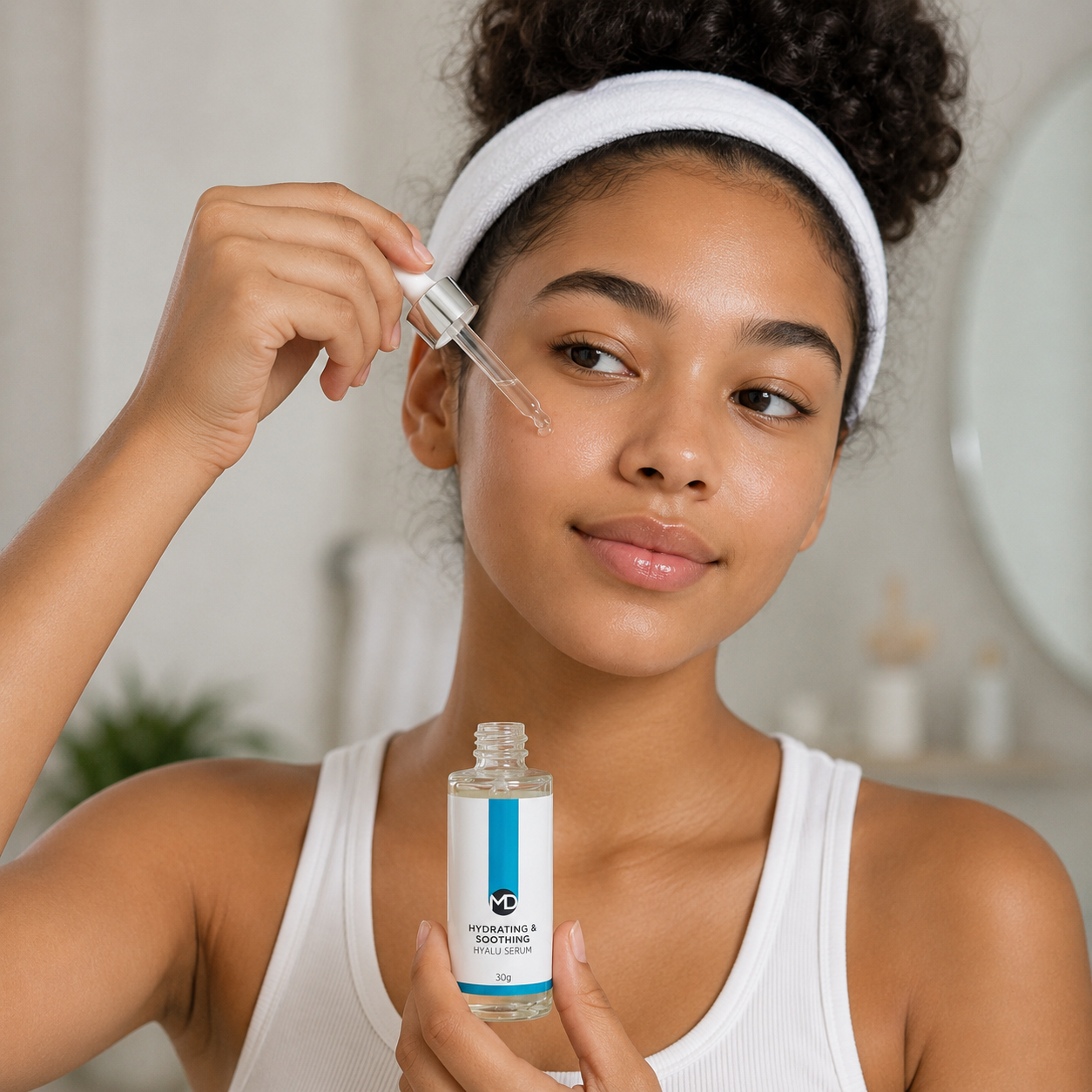
Recommended: MD Hydrating & Soothing Serum
Key ingredients
- Dual Hyaluronic Acid – Provides immediate and long-lasting hydration.
- Niacinamide – Supports the skin barrier while helping regulate oil production.
- Azelamidopropyl Dimethyl Amine – Helps improve excess oil and post-acne marks.
Best for
✔ Acne-prone skin
✔ Sensitive skin
✔ Dehydrated skin
✔ Teenagers using acne treatments
Not every teenager needs a moisturiser every day, but every teenager needs adequate hydration. A lightweight hydrating serum can often provide enough hydration for oily or combination skin, while teenagers with dry skin or those using acne treatments may benefit from adding a moisturiser.
Step 3: Moisturise When Needed
Many teenagers avoid moisturisers because they worry they will clog pores. The opposite is often true. A healthy skin barrier allows acne treatments to work better and reduces dryness caused by active ingredients.
Recommended: MD Moisture Rich Cream
Key ingredients
- Ceramides & Cholesterol – Restore the skin barrier.
- Niacinamide – Supports healthy skin function.
- Panthenol – Helps calm irritation.
Best for
✔ Dry skin
✔ Sensitive skin
✔ Teenagers using acne treatments
Step 4: Treat Acne Early
Early treatment reduces the risk of acne scars and post-acne pigmentation.
Recommended: MD Retinoid Cream
Key ingredients
- Hydroxypinacolone Retinoate (HPR) – A next-generation retinoid that binds directly to retinoid receptors, making it more effective than many traditional over-the-counter retinols while generally being better tolerated.
- Niacinamide – Helps reduce oil production and calm inflammation.
- Bakuchiol – Supports retinoid activity and improves tolerability.
Best for
✔ Mild to moderate acne
✔ Blackheads
✔ Whiteheads
✔ Oily skin
Dermatologist’s Advice
Start by applying the MD Retinoid Cream two to three evenings per week before gradually increasing frequency as your skin adapts. Mild dryness or peeling may occur during the first few weeks. Always use sunscreen during the day and avoid applying retinoids around the eyes, corners of the nose and lips. Retinoids should not be used during pregnancy unless advised by a healthcare professional.
For teenagers with acne, the best skincare routine for teenagers may also include benzoyl peroxide alongside a retinoid. Learn more in Does Benzac AC 5 Gel Remove Dark Spots? A Dermatologist Explains.
Step 5: Fade Acne Marks
Treating acne early is one of the best ways to prevent pigmentation, but if dark marks have already developed, they can usually be improved with the right skincare. Learn why these marks occur in Pigmentation in Skin of Colour: Why Dark Marks Last Longer Than the Pimple That Caused Them.
Recommended: MD MelanClear Serum
Key ingredients
- Tranexamic Acid – Helps reduce post-inflammatory pigmentation.
- Alpha-Arbutin – Helps reduce excess melanin production.
- Niacinamide – Helps brighten uneven skin tone while supporting the skin barrier.
Best for
✔ Acne marks
✔ Uneven skin tone
✔ Skin of colour
Dermatologist’s Tip: MelanClear helps fade existing acne marks, but daily sunscreen is essential to prevent those marks from becoming darker.
Step 6: Never Skip Sunscreen
No best skincare routine for teenagers is complete without daily sun protection. If you have a darker skin tone and struggle to find sunscreens without a white cast, read Sunscreen for Dark Skin: Bye-Bye White Cast, Hello Glow.
Recommended: MD Solar Safeguard SPF 50
Key ingredients
- Modern broad-spectrum UV filters – Protect against UVA and UVB rays.
- Vitamin E & Coenzyme Q10 – Provide antioxidant protection.
- Squalane – Helps maintain skin hydration.
Best for
✔ Every teenager
✔ Every skin type
Optional: Do Teenagers Need Vitamin C?
Vitamin C isn’t essential for every teenager, but it can be a helpful addition for those with post-acne pigmentation or uneven skin tone.
- MD Vitamin C + Glutathione Gel Serum is best suited to oily and acne-prone skin.
- MD Vitamin C 10% Jojoba Serum is ideal for normal to dry skin.
Both provide antioxidant protection while helping improve the appearance of acne marks.If you’re wondering whether vitamin C deserves a place in the best skincare routine for teenagers, our comparison of 2 MD Cosmeceuticals Vitamin C Serums Compared can help you choose the right formulation.
Best Skincare Routine for Teenagers According to Skin Concern
The best skincare routine for teenagers depends on your skin concerns. The routines below provide a simple guide, but not every teenager needs every product. Start with the basics, introduce active ingredients gradually, and choose products that match your skin type and concerns.
| If your main concern is… | Morning | Evening |
|---|---|---|
| Healthy skin | MD Gentle Cleanser → MD Hydrating & Soothing Serum → MD Solar Safeguard SPF 50 | MD Gentle Cleanser → MD Moisture Rich Cream (if needed) |
| Acne-prone skin | MD Gentle Cleanser → MD Hydrating & Soothing Serum → MD Solar Safeguard SPF 50 | MD Gentle Cleanser → MD Retinoid Cream → MD Moisture Rich Cream (if needed) |
| Acne + Dryness | MD Gentle Cleanser → MD Hydrating & Soothing Serum → MD Moisture Rich Cream → MD Solar Safeguard SPF 50 | MD Gentle Cleanser → MD Retinoid Cream → MD Moisture Rich Cream |
| Acne Marks (Post-Inflammatory Hyperpigmentation) | Option 1: MD Gentle Cleanser → MD Vitamin C + Glutathione Gel Serum (oily skin) or MD Vitamin C 10% Jojoba Serum (normal to dry skin) → MD Solar Safeguard SPF 50 | MD Gentle Cleanser → MD MelanClear Serum → MD Retinoid Cream → MD Moisture Rich Cream (if needed) |
Five Common Teenage Skincare Mistakes
- Using too many active ingredients at the same time.
- Washing your face more than twice a day.
- Skipping moisturiser because you have oily skin.
- Picking or squeezing pimples.
- Forgetting to wear sunscreen every day.
When Should You See a Dermatologist?
Book an appointment if:
- Acne is painful or cystic.
- Acne is leaving scars.
- Dark marks persist despite treatment.
- Your skin hasn’t improved after 8–12 weeks of consistent skincare.
- Acne is affecting your confidence or emotional well-being.
Frequently Asked Questions
At what age should a teenager start a skincare routine?
Most teenagers can benefit from a simple skincare routine once puberty begins, usually between 11 and 13 years of age. The focus should be on gentle cleansing, protecting the skin barrier and wearing sunscreen rather than using multiple active ingredients.
Does oily skin need a moisturiser?
Yes. Oily skin can still become dehydrated, especially when using acne treatments. A suitable moisturiser helps support the skin barrier, reduce irritation and improve tolerance to treatments such as retinoids and benzoyl peroxide.
Is the MD Retinoid Cream safe for teenagers?
The MD Retinoid Cream can be an excellent option for teenagers with acne when introduced gradually. Start by applying it two to three evenings per week before increasing frequency as tolerated. Mild dryness or peeling may occur during the first few weeks. Daily sunscreen is essential while using any retinoid.
How long does it take to see results?
Most acne treatments require patience. Many teenagers begin noticing improvement after 6 to 8 weeks, while post-acne dark marks may take several months to fade. Consistency is far more important than changing products frequently.
Can teenagers use MelanClear?
Yes. MD MelanClear is designed to help improve post-inflammatory hyperpigmentation—the dark marks that often remain after acne heals. It is most beneficial for teenagers with acne marks rather than those with active acne alone.
Do teenagers need a vitamin C serum?
Not always. A vitamin C serum is usually an optional step. It may benefit teenagers with post-acne pigmentation or uneven skin tone by providing antioxidant protection and supporting a brighter complexion.
Why is sunscreen important for teenagers?
Daily sunscreen protects the skin from ultraviolet damage and helps prevent post-acne marks from becoming darker. It also reduces the long-term risk of premature skin ageing and skin cancer.
Can I use MD Cosmeceuticals together with prescription acne medication?
In many cases, yes. The barrier-focused, fragrance-free formulations were developed to complement acne treatments by helping reduce dryness and irritation. However, if you are using prescription medications, it is best to follow the advice of your dermatologist regarding how and when to combine products.
Final Thoughts
The best skincare routine for teenagers doesn’t have to be complicated. In fact, the simplest routines are often the most effective. By focusing on a healthy skin barrier, treating acne early and protecting the skin from the sun, teenagers can reduce the risk of acne scars, post-inflammatory pigmentation and unnecessary irritation.
Every teenager’s skin is different, but the best skincare routine for teenagers is usually one that is simple, consistent and tailored to individual skin concerns. At MD Cosmeceuticals by Matete Derma, every formulation is built around one philosophy: Restore. Protect. Correct. Our fragrance-free, dermatologist-developed products combine evidence-based ingredients with barrier-supportive technology to help teenagers build healthy skincare habits that last well beyond adolescence.
If you’re unsure which products are right for your skin, consult a dermatologist who can recommend a routine tailored to your skin type and concerns. Book a consultation with our dermatologist.
References
- American Academy of Dermatology. Acne: Diagnosis and Treatment. American Academy of Dermatology Acne Guidelines
- American Academy of Dermatology. Skin Care Tips for Acne-Prone Skin. AAD Acne Skin Care Tips
- PubMed – Skin Barrier Dysfunction in Acne Vulgaris
- PubMed – Niacinamide in Dermatology: A Review of its Clinical Uses
Like & Share