Free shipping for orders over R 750.00
Receive samples with every order.
Reviewed by Dr Matete Mathobela – Specialist Dermatologist practising in Century City, Cape Town, Cape Gate Mediclinic and Life West Coast Private Hospital. Founder of MD Cosmeceuticals by Matete Derma and MD Dermoutlet.
Medical Disclaimer: This article is intended for educational purposes only and does not replace individual medical advice. If you have been prescribed an acne medication or topical retinoid, follow the instructions provided by your healthcare professional.
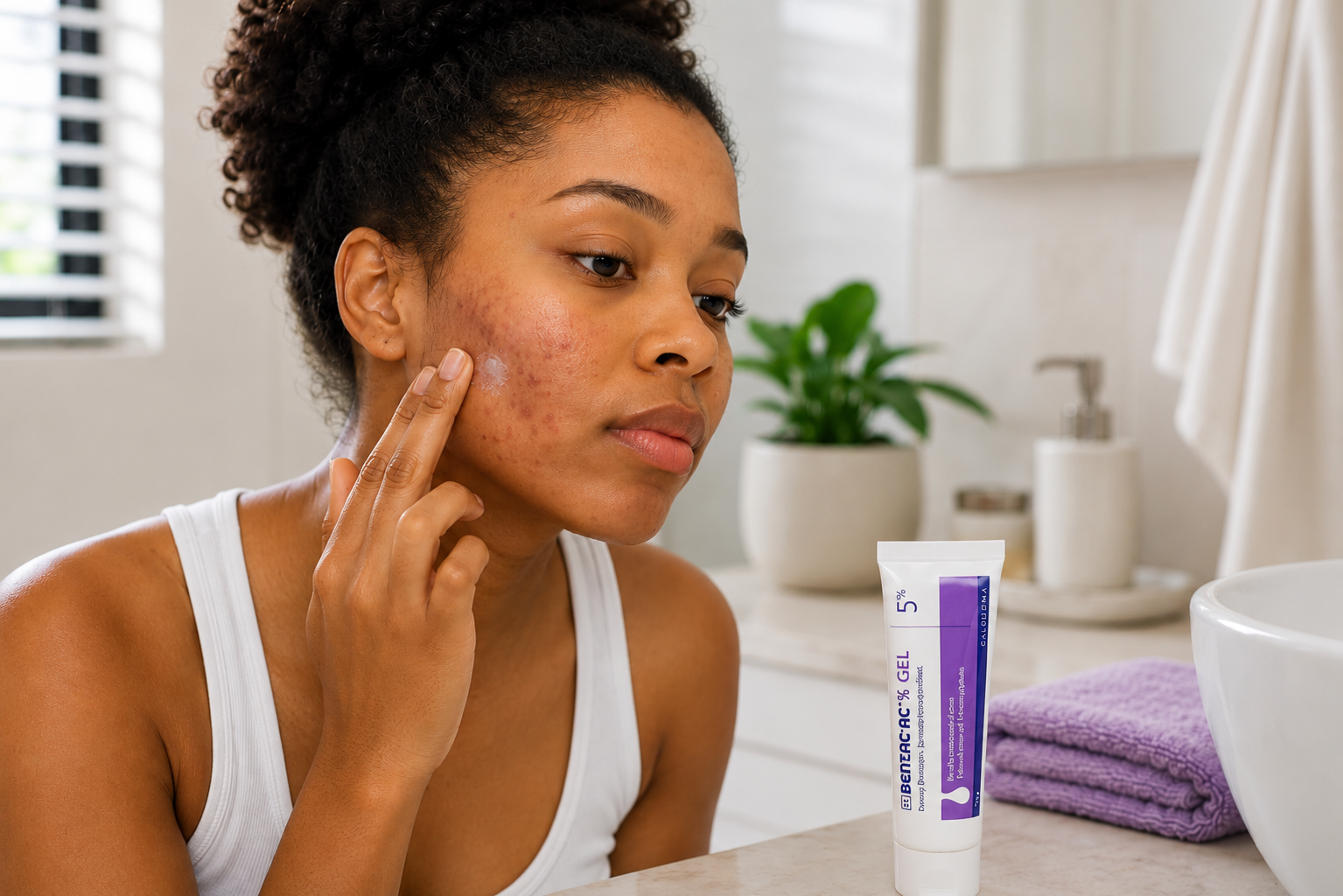
If your acne routine contains Benzac and a topical retinoid, you may be wondering: can you use Benzac with retinoids?
Yes, potentially. Benzac contains benzoyl peroxide, and benzoyl peroxide is commonly used as part of acne treatment alongside topical retinoids. However, not every retinoid should automatically be combined with Benzac in exactly the same way.
Adapalene is particularly straightforward because it is stable in the presence of benzoyl peroxide, and the two ingredients are well established as a combination acne treatment. Tretinoin may also be used in an acne regimen containing benzoyl peroxide, but formulation and timing can matter. (Nice)
Other topical retinoids used for acne include tazarotene and trifarotene. The appropriate regimen depends on the specific medication, formulation, your acne and how well your skin tolerates treatment. (AAD)
For a complete overview of the Benzac range and how benzoyl peroxide fits into acne treatment, read Benzac for Acne: A Dermatologist’s Complete Guide
Can you use Benzac with retinoids? Yes, but the specific retinoid matters.
Adapalene + benzoyl peroxide: A particularly well-established combination. They can even be formulated together in a single acne medication.
Tretinoin + benzoyl peroxide: Can potentially be used within the same acne treatment plan, but conventional tretinoin formulations have historically raised stability concerns when applied simultaneously with benzoyl peroxide. Formulation matters.
Other topical retinoids: May also form part of an acne regimen containing benzoyl peroxide, but follow the instructions for the specific medication.
Cosmetic retinol: Different from prescription acne retinoids and is not automatically necessary when you already have an effective acne treatment regimen.
The biggest practical issue when combining Benzac with retinoids is often irritation rather than whether the ingredients belong in the same acne treatment plan.
Acne develops through several interacting processes, including follicular blockage, increased sebum production, Cutibacterium acnes and inflammation.
Benzoyl peroxide and topical retinoids target different aspects of this process.
| Treatment | Main role in acne |
|---|---|
| Benzac / benzoyl peroxide | Reduces C. acnes and inflammation |
| Topical retinoids | Help normalise follicular keratinisation, unclog pores and prevent new comedones |
| Combination treatment | Targets multiple acne mechanisms |
This is particularly useful when someone has a mixture of inflammatory pimples and comedones such as blackheads and whiteheads.
Current American Academy of Dermatology acne guidelines strongly recommend both benzoyl peroxide and topical retinoids and encourage combining topical therapies with different mechanisms of action when appropriate. (AAD)
Adapalene deserves special attention because benzoyl peroxide + adapalene is one of the best-established retinoid combinations used in acne treatment.
The two ingredients complement each other:
Benzoyl peroxide → reduces C. acnes and inflammation.
Adapalene → helps prevent and treat comedones by normalising follicular keratinisation.
Adapalene is chemically stable in the presence of benzoyl peroxide, so the ingredients can be used together. Fixed-combination products containing adapalene and benzoyl peroxide are also established acne treatments. (Nice)
NICE currently lists fixed adapalene + benzoyl peroxide as a first-line option for acne and also recommends it as one possible maintenance treatment for people with frequent relapse. (Nice)
Yes.
There is no fundamental ingredient incompatibility requiring adapalene and benzoyl peroxide always to be separated.
However, both treatments can cause:
Someone who is new to both treatments may therefore find an aggressive routine difficult to tolerate.
Depending on the treatment plan, separate products might initially be used at different times of day.
For example:
Morning:
Gentle cleanser → Benzac → Moisturiser → Sunscreen
Evening:
Gentle cleanser → Adapalene → Moisturiser
This is an example rather than a universal rule.
If you have been prescribed a fixed adapalene/benzoyl peroxide medication, use it according to its instructions rather than trying to separate the ingredients yourself.
This is where the advice becomes more nuanced.
Tretinoin is another topical retinoid widely used for acne, but it should not automatically be treated exactly like adapalene.
Historically, there has been concern that benzoyl peroxide can oxidise and degrade conventional tretinoin formulations when the products are applied together.
However, this is formulation-dependent. Research has demonstrated that at least some optimised tretinoin formulations remain stable in the presence of benzoyl peroxide. (PubMed)
This is why a blanket statement such as “never use Benzac with tretinoin” is too simplistic.
At the same time, I would not recommend independently layering separate tretinoin and Benzac products simply because some formulations are compatible.
A practical regimen when separate products need to be kept apart may be:
Morning: Benzoyl peroxide
Evening: Tretinoin
If your dermatologist has prescribed tretinoin, follow the instructions for your particular formulation.
Adapalene and tretinoin are not the only topical retinoids used for acne.
Other options include tazarotene and trifarotene. The AAD includes adapalene, tretinoin, tazarotene and trifarotene among topical retinoids used in acne management. (AAD)
These medications should not automatically be inserted into a generic skincare layering routine.
If you have been prescribed one of them alongside Benzac, the important questions are:
Your prescribed treatment instructions take priority over general skincare layering rules.
Retinol is also part of the broader retinoid family, but a cosmetic retinol serum or cream is not the same thing as adapalene, tretinoin, tazarotene or trifarotene used as acne medications. (AAD)
It may be possible to incorporate a cosmetic retinol into a skincare routine containing Benzac.
But the more important question is whether you actually need it.
If you are already using an appropriately selected topical retinoid for acne, adding a separate cosmetic retinol usually adds unnecessary complexity and may increase irritation.
The goal is not to collect as many retinoids and acne actives as possible.
This is one of the most important parts of combining the treatments.
Both benzoyl peroxide and topical retinoids can irritate the skin, particularly during the early stages of treatment.
NICE specifically recommends considering alternate-day or short-contact application initially for potentially irritating topical acne treatments such as benzoyl peroxide and retinoids, before progressing to standard application if tolerated. (Nice)
Depending on your prescribed regimen, strategies may include:
If you already struggle with benzoyl peroxide irritation, read How to Use Benzac AC 5 Gel on Sensitive Skin: A Dermatologist’s Guide.
Moisturiser does not make your acne treatment ineffective.
Benzoyl peroxide and topical retinoids can both cause dryness and irritation, and an appropriate moisturiser can make these treatments easier to tolerate. The AAD specifically notes the usefulness of moisturiser when using treatments including benzoyl peroxide, adapalene, tretinoin and tazarotene. (AAD)
Your routine does not need to become complicated.
For many patients, the supporting skincare can remain:
Gentle cleanser + suitable moisturiser + sunscreen
with the acne medications incorporated according to the treatment plan.
Use broad-spectrum sunscreen every morning.
This is particularly important for someone prone to post-inflammatory hyperpigmentation, because acne inflammation can leave persistent dark marks, especially in darker skin tones.
If your treatment is also causing significant irritation, that additional inflammation is undesirable.
The goal is therefore:
Treat acne effectively → minimise unnecessary irritation → protect the skin
rather than trying to dry or exfoliate the acne away.
Potentially, but being able to combine ingredients does not mean that you need all of them.
If your routine already contains benzoyl peroxide and a topical retinoid, adding salicylic acid may increase irritation without necessarily adding meaningful benefit.
This is particularly true if you simultaneously introduce a salicylic acid cleanser, exfoliating toner and serum.
Keep the routine purposeful.
If another active ingredient is needed, there should be a reason for adding it.
Some dryness or mild peeling can occur after starting benzoyl peroxide or a topical retinoid.
Peeling, however, is not the goal of acne treatment and does not mean the medication is working better.
If you develop significant dryness, burning or irritation, the treatment regimen may need adjusting.
Marked swelling, blistering, severe burning or a significant rash should not simply be treated as normal adjustment.
Primarily, these are acne treatments.
Controlling acne can reduce the development of new post-inflammatory hyperpigmentation because fewer inflammatory lesions mean fewer opportunities for new dark marks to develop.
Topical retinoids may also have benefits for post-inflammatory pigmentation, but treating active acne and treating established pigmentation should still be approached thoughtfully rather than adding multiple pigment-correcting products at once. The AAD notes that topical retinoids can help with dark spots remaining after acne. (AAD)
If pigmentation is your main concern, read Does Benzac AC 5 Gel Remove Dark Spots? A Dermatologist Explains.
Consider professional assessment if:
Moderate-to-severe or scarring acne may require treatment beyond topical benzoyl peroxide and retinoids.
Benzac and topical retinoids can work very well together because they target different components of acne.
But I would not give every retinoid exactly the same instructions.
Adapalene has a particularly well-established relationship with benzoyl peroxide and can be formulated together with it. Tretinoin requires more attention to the formulation and timing, while other prescription retinoids should be used according to the specific treatment plan.
The other mistake I see is trying to make an effective acne regimen even “stronger” by adding acids, scrubs and several additional active serums.
More treatment is not necessarily better treatment.
The aim is to choose complementary acne medications, introduce them in a tolerable way and use them consistently enough to control the disease.
Yes. Benzoyl peroxide and topical retinoids are commonly used as complementary acne treatments. However, the best way to combine them depends on the specific retinoid and formulation.
Yes. Adapalene and benzoyl peroxide are a particularly well-established combination and are available together in fixed-combination acne treatments. (Nice)
Potentially, yes, but formulation matters. Conventional tretinoin formulations have historically raised concerns about degradation when used simultaneously with benzoyl peroxide, while some newer formulations have demonstrated stability. Your dermatologist may recommend separating products between morning and evening. (PubMed)
Yes, this can be a practical regimen for some separate-product combinations. However, it is not a universal requirement. Follow the instructions for the specific retinoid you are using.
Yes. Adapalene is stable in the presence of benzoyl peroxide. Fixed-combination products containing both ingredients are established acne treatments. (PubMed)
No. Retinol is commonly used as a cosmetic retinoid, whereas adapalene is a topical retinoid specifically used to treat acne. Tretinoin, tazarotene and trifarotene are other topical retinoids used in acne management.
Usually there is little reason to add a cosmetic retinol simply because you can. If adapalene is already being used as your topical retinoid for acne, adding another retinoid may unnecessarily complicate the routine and increase irritation.
Some people may notice an early increase in visible acne lesions after starting a topical retinoid, commonly described as “purging”. Benzoyl peroxide itself is not generally considered a classic purging treatment.
Read Does Benzac Cause Purging? A Dermatologist Explains for a detailed explanation.
Like & Share