





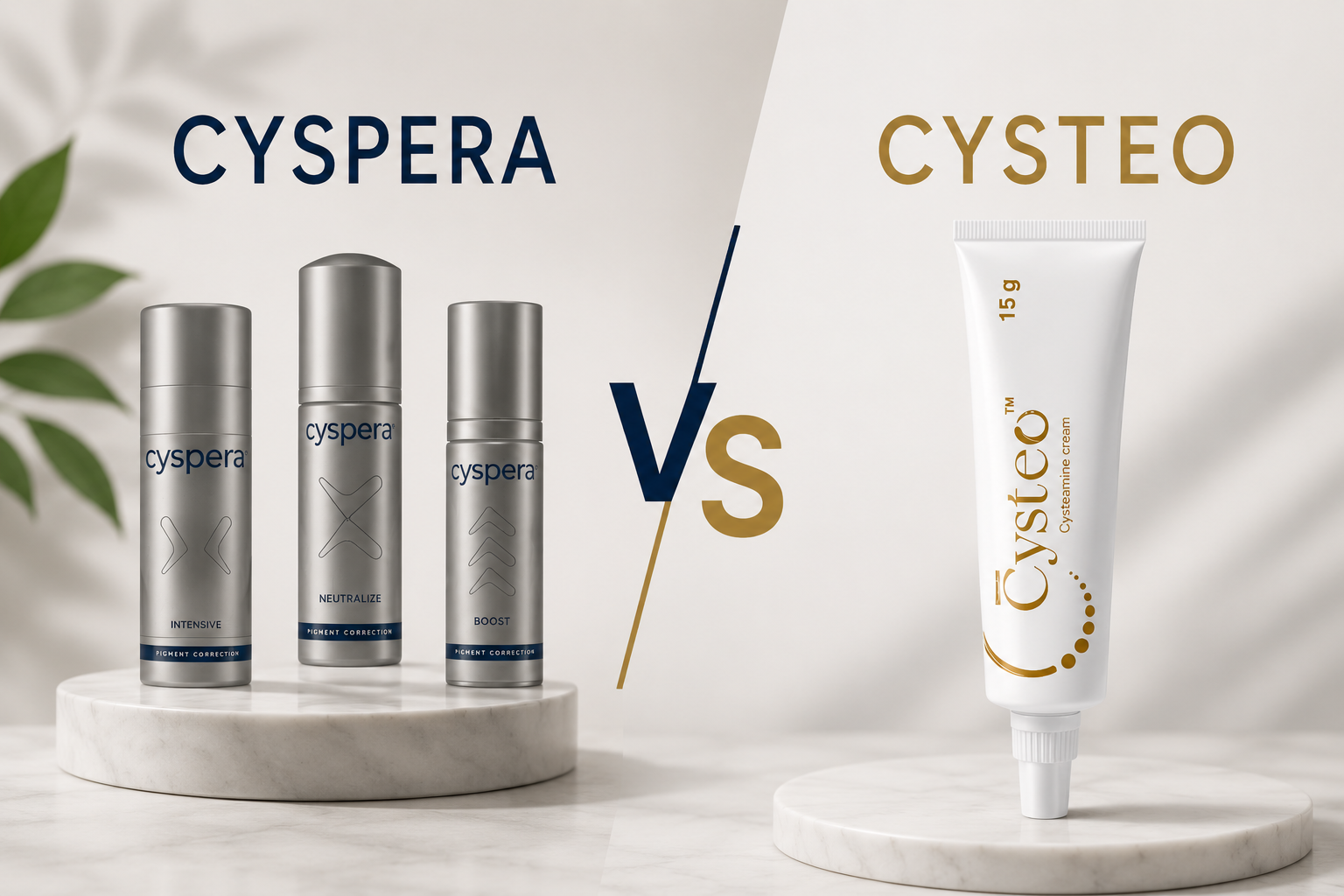
Cyspera vs Cysteo: Which Cysteamine Cream Is Best for Melasma and Dark Spots?
By Dr Matete Mathobela
Cyspera vs Cysteo: Which Cysteamine Cream Is Best for Melasma and Dark Spots?
If you’ve been searching for an effective treatment for melasma or stubborn dark spots, you’ve probably come across two popular cysteamine creams: Cyspera and Cysteo. This Cyspera vs Cysteo comparison explains how these products differ, who they are best suited for and why the formulation behind each product matters. Although both contain cysteamine as their main active ingredient, there are important differences in their ingredients, supporting technology, clinical evidence and additional skin benefits.
As a dermatologist, one of the questions I hear most often is:
“Should I buy Cyspera or Cysteo?”
The answer depends on your skin type, pigmentation severity, budget and skincare goals.
What is cysteamine?
Cysteamine is a naturally occurring antioxidant produced in human cells. When applied to the skin, it inhibits multiple pathways involved in melanin production, making it one of the most effective topical treatments for melasma and post-inflammatory hyperpigmentation.
Unlike hydroquinone, cysteamine can be used for long periods under dermatologist guidance without the risk of exogenous ochronosis associated with prolonged hydroquinone use.
If your pigmentation developed after acne rather than melasma, you’ll also find our article “Does Benzac AC 5 Gel Remove Dark Spots?” helpful, where we explain how inflammation leads to post-inflammatory hyperpigmentation and why preventing acne helps reduce future dark spots. You might also like to read our article that discuses Cysteamine and how it workd.
Cyspera vs Cysteo: What Do They Have in Common?
When comparing Cyspera vs Cysteo, it quickly becomes clear that both products are designed to reduce excess pigmentation using cysteamine. They are commonly recommended for patients with melasma, post-inflammatory hyperpigmentation and uneven skin tone.
Both products are designed to improve:
- Melasma
- Post-inflammatory hyperpigmentation (PIH)
- Sun-induced pigmentation
- Uneven skin tone
Both work best when combined with:
- Daily broad-spectrum SPF 50+ sunscreen
- A nighttime retinoid where appropriate
- Consistent sun protection
- Long-term adherence to treatment
One of the biggest questions patients ask during a Cyspera vs Cysteo consultation is why one product costs more than the other. The answer lies not only in the active ingredient but also in the supporting ingredients, formulation technology and the amount of published clinical evidence behind each product.
Cyspera vs Cysteo: What Makes Cyspera Different?
Although both Cyspera and Cysteo use cysteamine as their primary active ingredient, Cyspera has been developed as a comprehensive skin-correcting system rather than simply a cysteamine cream. Its formulation combines pigment correction with ingredients that support the skin barrier, improve skin quality and enhance tolerability.
Cysteamine
Cysteamine remains the hero ingredient. It inhibits multiple pathways involved in melanin production, making it highly effective for treating melasma, post-inflammatory hyperpigmentation and other forms of stubborn pigmentation.
Unlike hydroquinone, cysteamine can be used long term under dermatologist guidance without the risk of exogenous ochronosis.
Isobionic-Amide
One of Cyspera’s unique patented ingredients is Isobionic-Amide.
This ingredient was developed to support the skin barrier and reduce irritation associated with cysteamine treatment. Better tolerability means patients are more likely to continue treatment consistently, leading to improved long-term results.
Niacinamide (Vitamin B3)
Cyspera also contains niacinamide, a dermatologist favourite because of its multiple skin benefits.
Niacinamide helps:
- Strengthen the skin barrier
- Reduce inflammation
- Improve uneven skin tone
- Support fading of post-inflammatory hyperpigmentation
- Reduce transepidermal water loss
- Improve skin texture
- Help soften the appearance of fine lines and wrinkles
Supporting the skin barrier is just as important as reducing pigment. We discuss this further in our article “Protecting Your Barrier Through the Seasonal Shift”, where we explain why barrier health is fundamental to achieving long-term treatment success.
Barrier-Supporting Ingredients
Pigmentation treatments can sometimes lead to dryness or irritation. Cyspera includes moisturising and barrier-supporting ingredients that help maintain hydration while treatment is underway.
This is particularly important because excessive irritation can itself trigger new pigmentation, especially in patients with darker skin tones.
Proprietary Cysteamine Technology
One of the major differences between Cyspera and many other cysteamine creams is its proprietary formulation technology.
This technology is designed to:
- Improve cysteamine stability
- Enhance cosmetic elegance
- Improve patient comfort
- Optimise delivery of the active ingredient
More Than Pigment Correction
One of the biggest differences highlighted in this Cyspera vs Cysteo comparison is that Cyspera offers benefits beyond pigmentation correction alone.
Clinical studies and real-world experience have demonstrated improvements in:
- Overall skin brightness
- Skin smoothness
- Texture refinement
- Skin radiance
- Fine lines and wrinkles
- Overall skin quality
For patients looking to improve both pigmentation and early signs of ageing, these additional benefits make Cyspera an attractive treatment option.
Cyspera Intensive and Cyspera Intensive Sensitive
Another important advantage is that Cyspera is available in formulations designed for different skin needs.
Cyspera Intensive is suitable for most patients with melasma and stubborn pigmentation.
Cyspera Intensive Sensitive has been specifically developed for patients with reactive or easily irritated skin, allowing more people to benefit from cysteamine treatment while maintaining skin barrier health.
Cyspera vs Cysteo: Why Choose Cysteo?
Although Cyspera vs Cysteo is often viewed simply as a price comparison, the two products are designed with slightly different priorities. Cyspera focuses on maximising efficacy while improving skin quality and tolerability, whereas Cysteo offers a more affordable entry point into cysteamine therapy.
Cysteo may be suitable if you:
- Have mild to moderate pigmentation
- Are looking for a more affordable option
- Want to try cysteamine before investing in a premium formulation
- Already have a consistent skincare routine
Compared with Cyspera, however, there is currently less published clinical evidence supporting its formulation and fewer data demonstrating improvements in overall skin quality.
Cyspera vs Cysteo: Which One Should You Choose?
Choose Cyspera if you:
✔ Have moderate or severe melasma
✔ Have pigmentation that has not responded to previous treatments
✔ Want the formulation with the strongest clinical evidence
✔ Would also like improvements in skin texture, radiance and fine lines
✔ Have sensitive skin and would benefit from Cyspera Intensive Sensitive
Shop Cyspera online.
Choose Cysteo if you:
✔ Have mild pigmentation
✔ Are looking for a more affordable cysteamine cream
✔ Already use sunscreen and retinoids consistently
Shop Cysteo online.
Cyspera vs Cysteo: Which Works Better?
When discussing Cyspera vs Cysteo, both products can significantly improve pigmentation when used consistently alongside sunscreen and an appropriate skincare routine.
However, Cyspera offers several additional formulation advantages:
- Extensive clinical evidence
- Patented Isobionic-Amide technology
- Added niacinamide for barrier support
- Improved skin texture
- Improved radiance
- Softening of fine lines and wrinkles
- Better support for sensitive skin
- Advanced formulation technology designed to improve cosmetic elegance and tolerability
These additional benefits explain why Cyspera is often considered the premium cysteamine treatment.
Cyspera vs Cysteo: A Dermatologist’s Advice
One of the most important messages from this Cyspera vs Cysteo comparison is that neither product can overcome ongoing ultraviolet or visible light exposure.
Daily broad-spectrum SPF 50+ sunscreen remains the foundation of every successful pigmentation treatment plan. Choosing the correct sunscreen is just as important as selecting the right pigment-correcting cream.
We wrote an article on the effect of uv rays on hyperpigmentation, which emphasizes why sunscreen usage is so important.
Final Thoughts
After reviewing the evidence, this Cyspera vs Cysteo comparison shows that both products can successfully treat pigmentation. The best choice depends on your skin type, pigmentation severity, treatment goals and budget.
If your goal is treating mild pigmentation at a lower price point, Cysteo may be an appropriate option.
If you’re looking for the most clinically studied cysteamine formulation with additional benefits for skin texture, barrier health, fine lines and sensitive skin, Cyspera remains the more comprehensive treatment.
If you’re considering more options to manage your pigmentation after reading this Cyspera vs Cysteo guide, start with our article “Hyperpigmentation: Let’s talk the glow and how to get it back“ or consult your dermatologist to determine which cysteamine formulation is most appropriate for your skin.
Frequently Asked Questions
Which is better, Cyspera vs Cysteo?
For patients with moderate to severe melasma, sensitive skin or those looking for additional improvements in skin texture and fine lines, Cyspera offers several formulation advantages. Cysteo remains a good option for patients seeking a more affordable cysteamine treatment.
Is Cyspera worth the extra cost compared with Cysteo?
Many patients feel the additional investment is worthwhile because Cyspera combines cysteamine with barrier-supporting ingredients, patented Isobionic-Amide technology, niacinamide and clinically studied formulation technology designed to improve both effectiveness and tolerability.
How long does Cyspera take to work?
Most patients begin noticing improvement after 6–8 weeks, with continued improvement over 3–6 months.
Can Cyspera replace hydroquinone?
For many patients, yes. Cyspera is a hydroquinone-free alternative that can be used long term under dermatologist guidance.
Can sensitive skin use Cyspera?
Yes. Cyspera Intensive Sensitive was specifically developed for patients with sensitive or easily irritated skin.
Does Cyspera improve wrinkles?
Yes. In addition to improving pigmentation, clinical studies have demonstrated improvements in skin texture and the appearance of fine lines and wrinkles.
Can darker skin safely use Cyspera?
Yes. Cyspera has been extensively studied in Fitzpatrick skin types IV–VI and is considered an excellent treatment option for melasma and post-inflammatory hyperpigmentation in skin of colour.
References
- Cyspera official website
- PubMed – Cysteamine for melasma
- PubMed – Melasma treatment review
- American Academy of Dermatology – Melasma overview
If you struggling with hyperpigmentation and you don’t know were to start, book an appointment for a proper assessment and treatment recommendations with our dermatologist.
Like & Share