




The Skincare Ingredients Everyone Pronounces Wrong (And What They Actually Do)
By Precious Chida
Imagine walking into a skincare store and confidently asking for a product with “high-loo-ronic acid.”
The consultant smiles politely.
You smile back.
Nobody mentions that you’ve just accidentally invented a brand-new ingredient.
Modern skincare is packed with skincare ingredients that sound more like they belong in a university chemistry exam than on a moisturiser bottle. From niacinamide and cysteamine to polypodium leucotomos, some of the industry’s most popular ingredients are also the ones most likely to leave people second-guessing their pronunciation.
The funny part? Many of these complicated-sounding skincare ingredients are actually some of the simplest and most effective additions to a skincare routine.
Before you decide to avoid saying them out loud forever, let’s break down what they are, how to pronounce them, and most importantly, what they can do for your skin.
Skincare Ingredients Cheat Sheet
Some of the most popular skincare ingredients include:
- Niacinamide
- Hyaluronic Acid
- Retinol
- Salicylic Acid
- Azelaic Acid
- Ceramides
- Vitamin C
These ingredients are commonly used to help address concerns such as acne, dryness, pigmentation, sensitivity, and signs of ageing. Understanding what they do can make shopping for skincare much easier—and save you from buying products that don’t actually suit your skin.
1. Niacinamide
Pronounced: Nye-uh-sin-uh-mide
Common incorrect versions:
- Knee-see-na-mide
- Nia-cin-a-mide
- Nice-in-a-mide
What does it actually do?
Niacinamide is one of the hardest-working ingredients in skincare.
It helps:
- Reduce excess oil
- Strengthen the skin barrier
- Improve uneven skin tone
- Minimise the appearance of pores
- Calm redness
- Support acne-prone skin
The reason dermatologists love niacinamide is because it suits almost every skin type.
Whether your skin is oily, dry, sensitive, acne-prone, or dealing with pigmentation, niacinamide can usually help.
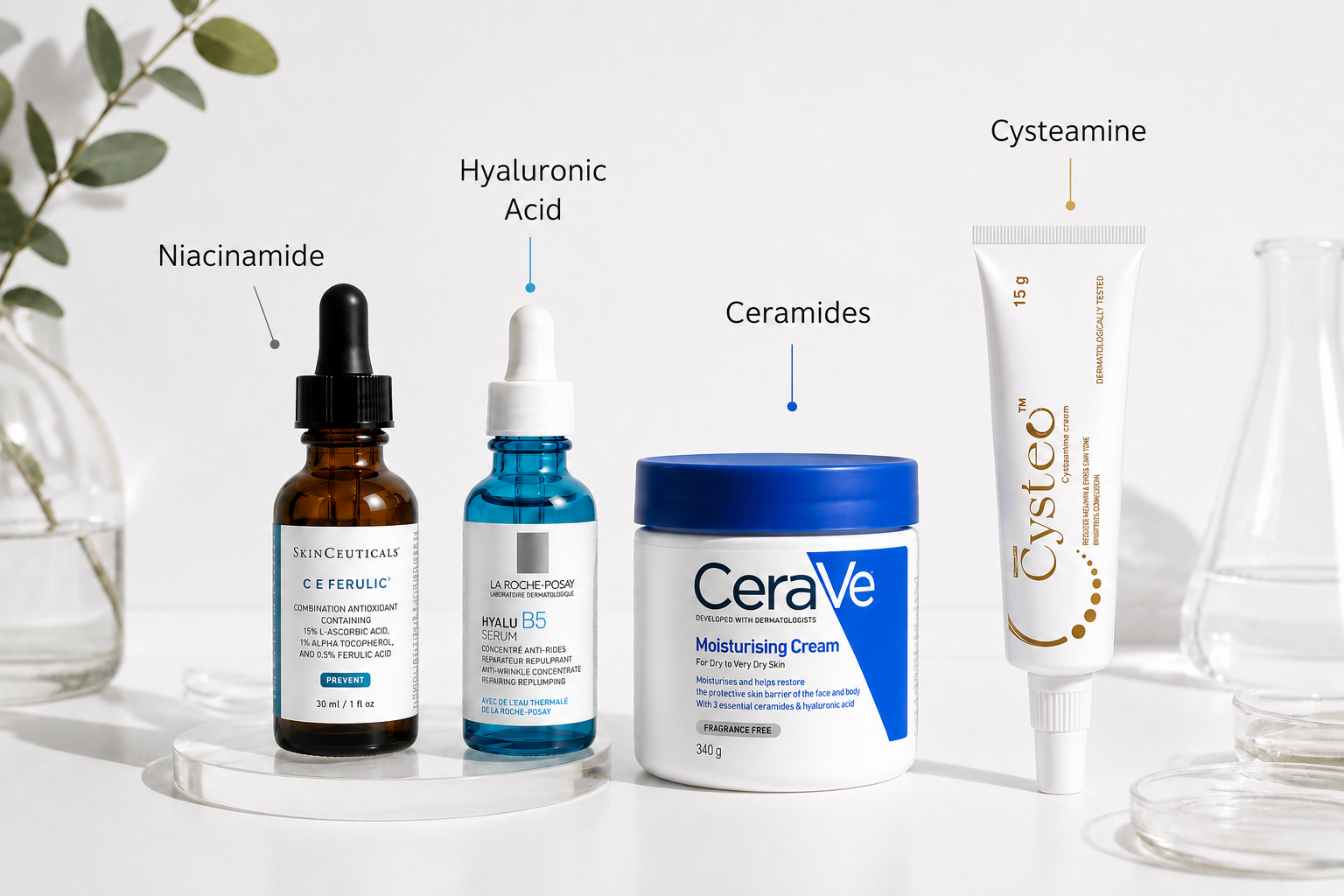
Product Examples
Think of niacinamide as the reliable friend of skincare. It may not be the flashiest ingredient, but it quietly does an excellent job.
2. Hyaluronic Acid
Pronounced: High-uh-loo-ron-ic Acid
Common incorrect versions:
- Hylauronic
- Hyluronic
- Hyaluronic
(Yes, many people accidentally skip an entire syllable.)
What does it actually do?
Contrary to what the word “acid” suggests, hyaluronic acid is not an exfoliating acid.
Instead, it is a powerful humectant.
That means it attracts water and helps keep skin hydrated.
In fact, hyaluronic acid can hold many times its weight in water, making it one of the most popular ingredients for:
- Dry skin
- Tight winter skin
- Dehydrated skin
- Fine lines caused by dryness
Product Examples
Winter in South Africa is often when hyaluronic acid really shines because cold air and indoor heating can leave skin feeling dry and uncomfortable.
Related Reading
Your Skin Is Dry, Tight and Dull This Winter — 7 Common Mistakes Dermatologists See Every Year
3. Cysteamine
Pronounced: Sis-tee-uh-meen
Common incorrect versions:
- Cyst-amine
- Sis-tamine
- Cys-tee-a-mine
What does it actually do?
If you’ve been researching pigmentation treatments lately, you’ve probably come across cysteamine.
It’s one of the most exciting ingredients used to help manage:
- Melasma
- Post-inflammatory hyperpigmentation
- Uneven skin tone
- Stubborn dark marks
Unlike some traditional depigmenting ingredients, cysteamine works through multiple pathways involved in pigment production.
Product Examples
Pigmentation is one of the most common concerns we see in dermatology, particularly in patients with darker skin tones where post-inflammatory pigmentation can linger long after acne or irritation has healed.
4. Salicylic Acid
Pronounced: Sally-sill-ick Acid
Common incorrect versions:
- Sally-cyclic
- Sally-cilic
- Salicilic
What does it actually do?
Salicylic acid belongs to a group called beta-hydroxy acids (BHAs).
Its superpower?
Getting deep into pores.
This makes it particularly useful for:
- Blackheads
- Whiteheads
- Acne-prone skin
- Oily skin
- Congested skin
Unlike many exfoliating acids that work mainly on the skin’s surface, salicylic acid can penetrate oil, helping to clear blockages inside pores.
Product Examples
If your pores could talk, they’d probably ask for salicylic acid.
5. Retinol
Pronounced: Ret-in-ol
Thankfully this one isn’t too difficult.
What does it actually do?
Retinol belongs to the vitamin A family and is often considered the gold standard in anti-ageing skincare.
Benefits include:
- Improving skin texture
- Supporting collagen production
- Softening fine lines
- Helping manage acne
- Improving pigmentation
Retinol has earned its reputation because it addresses multiple skin concerns at the same time.
The catch?
Patience.
Retinol is a marathon, not a sprint.
Results often take several weeks or months of consistent use.
Product Examples
- NeoStrata Correct Products
- La Roche-Posay Retinol B3 Serum
- SkinCeuticals Retinol Formulations
6. Polyhydroxy Acid (PHA)
Pronounced: Poly-Hydroxy Acid
Thankfully easier than it looks.
What does it actually do?
PHAs are often described as the gentler cousins of AHAs.
They provide exfoliation while being kinder to sensitive skin.
Benefits include:
- Smoother skin texture
- Gentle exfoliation
- Improved hydration
- Reduced irritation compared with stronger acids
If you’ve tried glycolic acid and found it too harsh, PHAs may be worth exploring.
7. Ceramides
Pronounced: Ser-uh-mides
What do they actually do?
Ceramides are naturally found in your skin.
Think of them as the cement between the bricks of a wall.
The bricks are your skin cells.
The cement is what keeps everything together.
When ceramides are depleted, the skin barrier becomes weaker, leading to:
- Dryness
- Irritation
- Sensitivity
- Increased water loss
Product Examples
This is one of the reasons ceramide-rich moisturisers are particularly popular during winter.
8. Polypodium Leucotomos
Pronounced: Poly-poh-dee-um Loo-co-toe-mos
Congratulations if you got that right on the first attempt.
Most people don’t.
What does it actually do?
Polypodium leucotomos is a tropical fern extract that has gained attention for its photoprotective properties.
While it is not a replacement for sunscreen, it may help support skin protection against UV-induced damage when used as part of a comprehensive sun protection strategy.
Product Example
This ingredient has become increasingly popular among individuals managing pigmentation disorders and those looking for additional support alongside daily sunscreen use.
9. Azelaic Acid
Pronounced: Uh-zeh-lay-ick Acid
What does it actually do?
Azelaic acid doesn’t always get the same attention as retinol or vitamin C, but dermatologists appreciate it for good reason.
Benefits include:
- Reducing redness
- Supporting rosacea-prone skin
- Helping acne
- Improving pigmentation
- Brightening uneven skin tone
It is one of the few ingredients that can tackle multiple concerns without being excessively irritating.
10. Tocopherol
Pronounced: Toe-cof-er-ol
What does it actually do?
Tocopherol is simply another name for Vitamin E.
You’ll often find it paired with Vitamin C because the two work exceptionally well together.
Benefits include:
- Antioxidant protection
- Support against environmental stressors
- Additional moisturising benefits
- Enhanced photoprotection when combined with sunscreen
Product Examples
- MD Cosmeceuticals Vitamin C Serum
- SkinCeuticals C E Ferulic
- Various antioxidant serums and moisturisers
Why Ingredient Knowledge Matters
Here’s something many skincare shoppers don’t realise.
The name on the front of the bottle often matters less than the ingredients on the back.
Understanding ingredients helps you:
- Choose products more confidently
- Avoid buying duplicates
- Build a smarter routine
- Understand what your skin actually needs
- Spend your skincare budget more wisely
And as a bonus, you’ll never have to nervously mumble “niacinamide” at the skincare counter again.
Frequently Asked Questions
What is the most important skincare ingredient?
There is no single best ingredient. The right choice depends on your skin concern, whether that’s acne, dryness, pigmentation, or ageing.
Is hyaluronic acid an exfoliating acid?
No. Hyaluronic acid is a hydrating ingredient that helps attract water to the skin.
Can niacinamide and vitamin C be used together?
Yes. Modern research shows these ingredients can work well together.
Which skincare ingredient is best for acne-prone skin?
Salicylic acid, niacinamide, retinol, and azelaic acid are among the most commonly recommended ingredients for acne-prone skin.
Which skincare ingredient is best for dry skin?
Hyaluronic acid and ceramides are two of the most popular ingredients for helping to support hydration and maintain a healthy skin barrier.
Final Thoughts
The next time you stumble across a complicated ingredient name, remember that most people are struggling with the pronunciation too.
What matters most isn’t saying the word perfectly.
It’s understanding what that skincare ingredient can do for your skin.
Whether it’s niacinamide helping with oil control, hyaluronic acid supporting hydration, cysteamine targeting pigmentation, or ceramides strengthening your skin barrier, the real magic happens when the right ingredient meets the right skin concern.
So if you’ve been secretly calling it “nice-in-a-mide” all this time, don’t worry.
Your skin wasn’t judging you.
Related Reading
- Winter Skincare South Africa: 7 Common Mistakes Dermatologists See Every Year
- How To Build A Simple Skincare Routine That Actually Works
- MD Dermoutlet Best Sellers: What Customers Are Buying This Winter
Disclaimer
This article is intended for educational purposes only and does not replace professional medical advice, diagnosis, or treatment. Always consult your dermatologist or healthcare professional regarding concerns about your skin or before starting new skincare products.
References
- American Academy of Dermatology (AAD) – Skin Care Ingredients Guide https://www.aad.org/public/everyday-care/skin-care-secrets/routine/skin-care-ingredients
- DermNet NZ – Niacinamide https://dermnetnz.org/topics/niacinamide
- DermNet NZ – Hyaluronic Acid https://dermnetnz.org/topics/hyaluronic-acid
- DermNet NZ – Azelaic Acid https://dermnetnz.org/topics/azelaic-acid
- DermNet NZ – Salicylic Acid https://dermnetnz.org/topics/salicylic-acid
- British Association of Dermatologists https://www.bad.org.uk/
- National Eczema Association – Ceramides and Skin Barrier Function https://nationaleczema.org/eczema/treatment/moisturizing/ceramides/


Like & Share