





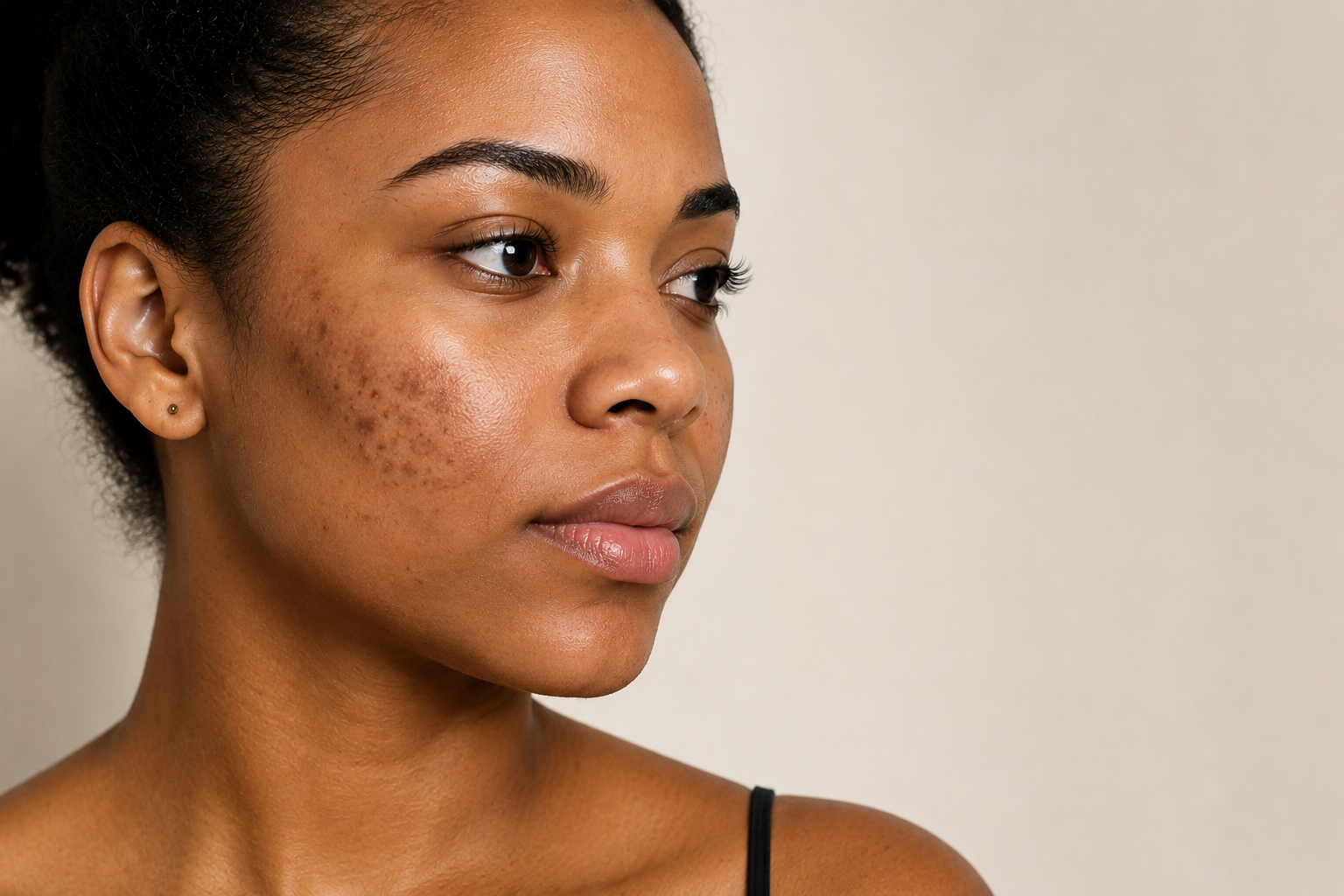
7 Effective Hyperpigmentation Treatments in South Africa
By Dr Matete Mathobela
Reviewed by Dr Matete Mathobela – Specialist Dermatologist
Founder of MD DermOutlet and MD Cosmeceuticals by Matete Derma
Read more about Dr Matete Mathobela →
Medical Disclaimer
This article is for educational purposes and does not replace individual medical advice. Persistent, unusual, asymmetrical or changing pigmentation should be professionally assessed.
Hyperpigmentation Treatment South Africa: What Are the Best Options?
When considering hyperpigmentation treatment South Africa patients have many options, but the right approach starts with the correct diagnosis.
Dark marks may represent post-inflammatory hyperpigmentation (PIH), melasma, sun-related pigmentation or another pigmentary disorder. These conditions can look similar but do not necessarily require the same treatment.
That is why seeing a dermatologist can be important before repeatedly trying stronger brightening products, chemical peels or lasers.
1. Start With the Correct Diagnosis
Before asking “What will fade this?”, first ask “What is causing it?”
A dermatologist can assess the pattern and likely diagnosis and determine whether an underlying condition such as acne, eczema or folliculitis also needs treatment.
2. Make Tinted Sunscreen Part of Treatment
Photoprotection is fundamental to hyperpigmentation treatment in South Africa.
UV radiation can worsen pigmentation, but visible light can also contribute, particularly in darker skin tones. For pigmentation-prone skin, a broad-spectrum tinted sunscreen containing iron oxides can provide additional protection against visible light compared with conventional untinted sunscreen.
Oral Polypodium leucotomos extract may also be considered as an adjunct in selected patients, particularly in melasma, but it does not replace sunscreen. Clinical studies have evaluated it alongside established topical treatment and photoprotection.
Shop Sunscreens & Photoprotection →
3. Choose Evidence-Based Pigment Ingredients
There is no single best brightening ingredient.
Depending on the diagnosis, options may include hydroquinone, retinoids, azelaic acid, tranexamic acid, Thiamidol, 4-butylresorcinol, cysteamine, kojic acid, arbutin and niacinamide.
Cysteamine is a non-hydroquinone depigmenting option with clinical evidence, particularly in melasma.
Vitamin C can also be useful as an antioxidant with additional pigment-targeting benefits, making it a helpful supportive ingredient in some pigmentation routines.
Thiamidol targets human tyrosinase and is available in pigmentation formulations through major retailers in South Africa.
4. Consider Multi-Pathway Formulations
Pigmentation involves several biological pathways, so formulations combining complementary ingredients can be useful.
Examples include MD Cosmeceuticals MelanClear, SkinCeuticals Discoloration Defense, Mesoestetic Melan Tran3x, ME LINE and selected NeoStrata Enlighten products.
For example, SkinCeuticals Discoloration Defense combines 3% tranexamic acid, 1% kojic acid, 5% niacinamide and 5% HEPES, providing complementary pigment-targeting and exfoliating actions. (SkinCeuticals)
The goal is not to choose the product with the longest ingredient list. It is to select a formulation whose mechanisms suit the type and cause of the pigmentation.
Shop Hyperpigmentation Skincare →
5. Treat What Is Causing the Dark Marks
For PIH, fading existing marks is only half the job.
If acne, eczema, folliculitis or another inflammatory condition continues, new pigmentation can continue to develop. Treating the underlying inflammation is therefore an important part of a successful pigmentation plan.
6. Chemical Peels Can Help
Selected superficial chemical peels can complement topical treatment, but stronger is not necessarily better, particularly in darker skin.
Treatments need to be selected carefully because irritation itself can trigger or worsen PIH. Evidence for PIH treatments in skin of colour supports several approaches but also highlights limitations in the available research.
Explore Chemical Peel Treatments →
7. Laser Is for Selected Patients
Laser and other energy-based treatments may help selected resistant pigmentation, but they are not appropriate for every pigmentation disorder or every patient.
This is particularly important in darker skin tones, where inappropriate treatment or excessive inflammation may worsen pigmentation.
Dermatologist’s Perspective
When choosing hyperpigmentation treatment South Africa patients should remember that the strongest serum, peel or laser is not necessarily the best option.
Diagnosis comes first.
Once we understand why the pigmentation is present, we can combine appropriate photoprotection, targeted ingredients and, where necessary, procedures while minimising irritation and the risk of making pigmentation worse.
If you are unsure what is causing your pigmentation, consider seeing a dermatologist before escalating treatment.
Book a Dermatology Consultation →
Shop Hyperpigmentation Skincare →
Related Reading
Melasma is particularly complex and often needs a multi-pathway approach.
Melasma: Why It Happens and How We Treat It →
References
- Mar K, et al. Treatment of Post-Inflammatory Hyperpigmentation in Skin of Colour: A Systematic Review. J Cutan Med Surg. 2024;28(5):473–480.
View on PubMed - Mar K, et al. Prevention of Post-Inflammatory Hyperpigmentation in Skin of Colour: A Systematic Review. Australas J Dermatol. 2025;66(3):119–126.
View on PubMed - Guide to Tinted Sunscreens in Skin of Color. International Journal of Dermatology.
View on PubMed - Ahmed AM, et al. A randomized, double-blinded, placebo-controlled trial of oral Polypodium leucotomos extract as an adjunct to sunscreen in the treatment of melasma. JAMA Dermatol. 2013.
View on PubMed
Like & Share