





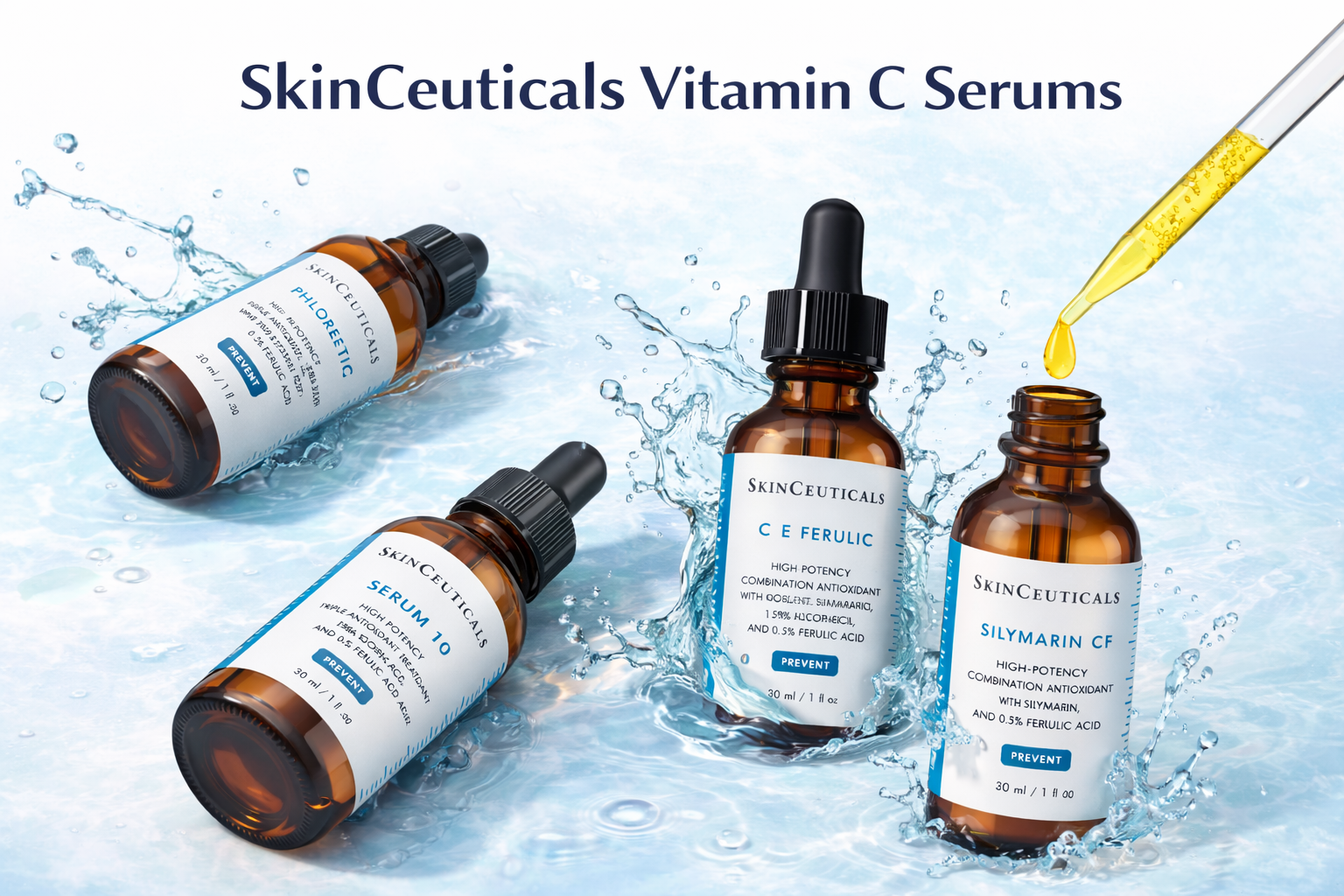
4 SkinCeuticals Vitamin C Serums Compared: Which One Is Right for Your Skin?
By Dr Mathobela
Reviewed by Dr Matete Mathobela
Reviewed by Dr Matete Mathobela – Specialist Dermatologist practising in Century City, Cape Town, Cape Gate Mediclinic and Life West Coast Private Hospital. Founder of MD Cosmeceuticals by Matete Derma and MD Dermoutlet.
With over a decade of experience treating pigmentation, acne, melasma, rosacea and skin ageing, Dr Matete regularly recommends evidence-based antioxidant skincare tailored to each patient’s skin type, concerns and treatment goals.
Medical Disclaimer
This article is intended for educational purposes only and should not replace professional medical advice, diagnosis or treatment. Every person’s skin is different, and the most suitable Vitamin C serum depends on your skin type, skincare routine and individual concerns. If you are unsure which product is right for you, consult a dermatologist for personalised advice.
Introduction
SkinCeuticals Vitamin C Serums are considered the gold standard in antioxidant skincare, combining decades of scientific research with clinically proven ingredients to help protect the skin against environmental damage while improving pigmentation, collagen production and visible signs of ageing. Trusted by dermatologists worldwide, these formulations are designed to deliver stable, highly effective Vitamin C to the skin, making them some of the most researched topical antioxidant serums available today.
Although all four SkinCeuticals Vitamin C Serums contain L-ascorbic acid, they were developed for different skin types and concerns. Some are better suited to sensitive skin, while others are formulated specifically for pigmentation, acne-prone skin or advanced photoageing. Choosing the right formulation is therefore far more important than simply selecting the highest Vitamin C concentration.
In this dermatologist-reviewed comparison, we’ll explore the four SkinCeuticals Vitamin C Serums available at MD Dermoutlet, compare their ingredients, explain the science behind each formulation and help you decide which serum is best suited to your skin.
The effectiveness of SkinCeuticals Vitamin C Serums is supported by decades of scientific research into topical Vitamin C. L-ascorbic acid is one of the most extensively studied ingredients in dermatology, recognised for its ability to neutralise free radicals, stimulate collagen production and improve the appearance of hyperpigmentation while helping protect the skin against environmental damage. Clinical evidence continues to support its role in maintaining healthier, more resilient skin.
Reference:Vitamin C in Dermatology – https://pubmed.ncbi.nlm.nih.gov/19924129/
At MD Dermoutlet, we stock a carefully selected range of SkinCeuticals Vitamin C Serums to suit different skin types and concerns. Whether you’re looking to target pigmentation, early signs of ageing, excess oil or sensitive skin, our dermatologist-selected range includes a formulation designed for your needs.
Browse the complete SkinCeuticals range: https://www.mddermoutlet.co.za/brand/skinceuticals/
2-Minute Read
Choosing between the SkinCeuticals Vitamin C Serums doesn’t have to be complicated.
Each formulation has been developed for a specific skin type and concern:
- Serum 10 – Best for sensitive skin and first-time Vitamin C users.
- C E Ferulic – Ideal for dry, mature and ageing skin.
- Phloretin CF – Best for pigmentation, uneven skin tone and normal to oily skin.
- Silymarin CF – Designed specifically for oily and acne-prone skin.
While they all provide powerful antioxidant protection, their supporting ingredients make each serum unique. Understanding these differences will help you invest in the formulation that’s most likely to deliver the results you’re looking for.
In a Nutshell
The SkinCeuticals Vitamin C Serums are among the most scientifically researched topical antioxidant formulations in dermatology. Built around the patented Duke Antioxidant Technology, these serums are formulated to maximise the stability, absorption and effectiveness of pure L-ascorbic acid.
Rather than producing a single Vitamin C serum for every skin type, SkinCeuticals developed four distinct formulations to address different concerns, including sensitive skin, pigmentation, acne-prone skin and visible signs of ageing.
In this guide, we’ll compare each serum side by side, explain who it’s best suited for and share how I choose between them in clinical practice.
What You’ll Learn
By the end of this guide, you’ll understand:
- Why SkinCeuticals Vitamin C Serums are different from many other Vitamin C products.
- The key ingredients found in each formulation.
- Which serum is best for pigmentation.
- Which formulation is most suitable for oily and acne-prone skin.
- Which Vitamin C serum dermatologists commonly recommend for ageing skin.
- Whether a higher Vitamin C percentage always produces better results.
- How to incorporate a SkinCeuticals Vitamin C serum into your morning skincare routine.
- How I choose between these serums for different patients in clinical practice.
Why Choose a SkinCeuticals Vitamin C Serum?
SkinCeuticals Vitamin C Serums are formulated using the renowned Duke Antioxidant Patent, which demonstrated that topical L-ascorbic acid is most effective when formulated within a specific concentration range and at an acidic pH. This breakthrough has helped establish SkinCeuticals as one of the most trusted antioxidant skincare brands recommended by dermatologists worldwide.
Topical antioxidants play an important role in protecting the skin from environmental damage caused by ultraviolet (UV) radiation and pollution. By helping to neutralise free radicals before they damage skin cells, they support healthier, more resilient skin and may reduce the visible signs of premature ageing. This protective effect has been demonstrated in clinical research on topical antioxidants and photoprotection. Reference: Topical Antioxidants and Photoprotection – https://pubmed.ncbi.nlm.nih.gov/12582321/
Key Benefits of SkinCeuticals Vitamin C Serums
- Protect the skin against environmental damage caused by UV radiation and pollution.
- Help reduce the appearance of fine lines and wrinkles.
- Brighten uneven skin tone and improve radiance.
- Support firmer, healthier-looking skin.
- Improve the appearance of pigmentation and post-inflammatory hyperpigmentation.
One of Vitamin C’s most important functions is its role in collagen synthesis. As an essential cofactor in collagen production, it helps maintain the skin’s structure and firmness while supporting the natural repair process. This is one of the reasons Vitamin C is widely recommended in anti-ageing skincare routines. Reference: Vitamin C and Collagen Synthesis – https://pubmed.ncbi.nlm.nih.gov/18505436/
Does a Higher Vitamin C Percentage Mean a Better Serum?
One of the biggest misconceptions about SkinCeuticals Vitamin C Serums is that the formulation with the highest Vitamin C percentage automatically delivers the best results.
In reality, the effectiveness of a Vitamin C serum depends on far more than its concentration of L-ascorbic acid.
Each SkinCeuticals formulation combines Vitamin C with carefully selected antioxidants and active ingredients to target specific skin concerns.
For example:
- Serum 10 contains 10% L-ascorbic acid, making it an excellent option for sensitive skin and beginners.
- C E Ferulic combines 15% L-ascorbic acid with Vitamin E and ferulic acid to target visible signs of ageing.
- Phloretin CF pairs 10% L-ascorbic acid with phloretin to help improve pigmentation and uneven skin tone.
- Silymarin CF combines 15% L-ascorbic acid with silymarin and salicylic acid to help reduce excess oil while providing antioxidant protection.
The best serum isn’t necessarily the one with the highest Vitamin C concentration—it’s the one that best matches your skin type and treatment goals.
Shop the SkinCeuticals Range
Explore the complete SkinCeuticals collection available at MD Dermoutlet:
https://www.mddermoutlet.co.za/brand/skinceuticals
Which SkinCeuticals Vitamin C Serum Is Right for You?
Although all four SkinCeuticals Vitamin C Serums provide powerful antioxidant protection, they were developed for different skin types and concerns. The best serum isn’t necessarily the one with the highest Vitamin C concentration—it’s the one formulated to address your specific skincare goals.
The comparison below highlights the key differences to help you make an informed decision.
SkinCeuticals Vitamin C Serums Comparison Table
| Serum | Vitamin C Concentration | Supporting Ingredients | Best For |
|---|---|---|---|
| Serum 10 | 10% L-Ascorbic Acid | 0.2% Ferulic Acid | Sensitive skin, beginners, younger skin |
| C E Ferulic | 15% L-Ascorbic Acid | 1% Vitamin E, 0.5% Ferulic Acid | Dry, normal and mature skin with wrinkles and sun damage |
| Phloretin CF | 10% L-Ascorbic Acid | 2% Phloretin, 0.5% Ferulic Acid | Pigmentation, uneven skin tone, normal to oily skin |
| Silymarin CF | 15% L-Ascorbic Acid | 0.5% Silymarin, 0.5% Ferulic Acid, 0.5% Salicylic Acid | Oily, combination and acne-prone skin |
Does a Higher Vitamin C Percentage Mean Better Results?
One of the biggest misconceptions about SkinCeuticals Vitamin C Serums is that a higher Vitamin C percentage automatically produces better results.
In reality, the supporting ingredients are just as important as the Vitamin C concentration.
For example, although C E Ferulic and Silymarin CF both contain 15% L-ascorbic acid, they were designed for completely different skin concerns. Likewise, Serum 10 and Phloretin CF both contain 10% L-ascorbic acid, yet their supporting antioxidants make them suitable for different patients.
As a dermatologist, I choose the formulation based on the patient’s skin type, barrier function, pigmentation, oil production and treatment goals—not simply the Vitamin C percentage.
Vitamin C also plays an important role in improving the appearance of hyperpigmentation. Research has shown that topical Vitamin C can help reduce uneven skin tone by influencing melanin production while protecting the skin against oxidative stress. This is one of the reasons Vitamin C remains a cornerstone ingredient in dermatologist-recommended pigmentation treatment plans.
Reference: Vitamin C and Hyperpigmentation
https://pubmed.ncbi.nlm.nih.gov/17927577/
Now that we’ve looked at how the formulations differ, let’s take a closer look at each SkinCeuticals Vitamin C Serum and discover who it is best suited for.
SkinCeuticals Serum 10
Best for Sensitive Skin and First-Time Vitamin C Users
If you’re new to topical Vitamin C or have easily irritated skin, Serum 10 is usually the best place to start.
It contains 10% pure L-ascorbic acid, providing effective antioxidant protection while being gentler than higher-strength formulations. Combined with 0.2% ferulic acid, it helps defend the skin against free radicals generated by ultraviolet radiation and pollution.
Key Benefits
- Introduces Vitamin C gently.
- Helps brighten dull skin.
- Supports collagen production.
- Protects against environmental damage.
- Suitable for sensitive skin.
- Ideal for younger patients beginning preventative skincare.
Dermatologist’s Perspective
I often recommend Serum 10 for patients who have never used Vitamin C before, particularly those with sensitive skin or a compromised skin barrier. Starting with a lower concentration often improves tolerance and long-term compliance.
SkinCeuticals C E Ferulic
Best for Ageing, Dry and Sun-Damaged Skin
C E Ferulic is arguably the most recognised antioxidant serum in the SkinCeuticals range and has been extensively studied in clinical research.
It combines:
- 15% L-ascorbic acid
- 1% Alpha-Tocopherol (Vitamin E)
- 0.5% Ferulic Acid
This combination provides exceptional antioxidant protection while helping improve collagen production, skin firmness and visible signs of ageing.
Key Benefits
- Improves fine lines and wrinkles.
- Helps stimulate collagen production.
- Enhances skin firmness.
- Brightens dull, photodamaged skin.
- Provides advanced environmental protection.
- Ideal for normal, dry and mature skin.
Dermatologist’s Perspective
For patients concerned about photoageing, loss of firmness and fine lines, C E Ferulic remains one of my preferred antioxidant serums. It integrates well into comprehensive anti-ageing routines alongside sunscreen and, where appropriate, retinoids.
SkinCeuticals Phloretin CF
Best for Pigmentation and Uneven Skin Tone
Phloretin CF was developed for patients with normal to oily skin who want antioxidant protection while addressing uneven pigmentation.
It contains:
- 10% L-ascorbic acid
- 2% Phloretin
- 0.5% Ferulic Acid
Phloretin helps improve the appearance of discolouration while enhancing the overall antioxidant performance of the formulation.
Key Benefits
- Brightens uneven skin tone.
- Improves the appearance of pigmentation.
- Supports a more radiant complexion.
- Provides antioxidant protection.
- Suitable for normal to oily skin.
Dermatologist’s Perspective
I frequently recommend Phloretin CF for patients managing post-inflammatory hyperpigmentation or uneven skin tone, particularly when combined with daily sunscreen and other pigment-correcting treatments as part of a personalised skincare plan.
SkinCeuticals Silymarin CF
Best for Oily and Acne-Prone Skin
Silymarin CF is the newest addition to the SkinCeuticals antioxidant family and was specifically formulated for oily and blemish-prone skin.
Its formula includes:
- 15% L-ascorbic acid
- 0.5% Silymarin
- 0.5% Ferulic Acid
- 0.5% Salicylic Acid
Unlike the other Vitamin C serums, Silymarin CF combines antioxidant protection with ingredients that help address excess oil and support clearer-looking skin.
Key Benefits
- Helps reduce excess oil.
- Supports acne-prone skin.
- Provides advanced antioxidant protection.
- Brightens post-acne marks.
- Improves overall skin clarity.
- Suitable for oily and combination skin.
Dermatologist’s Perspective
For patients with oily or acne-prone skin, Silymarin CF is often my first choice. It delivers the antioxidant benefits of Vitamin C while addressing concerns that traditional anti-ageing formulations may not target, making it particularly useful for adults with acne and early signs of photoageing.
Quick Dermatologist Recommendations
If you’re still unsure which of the SkinCeuticals Vitamin C Serums is right for you, here’s a simple guide:
Choose Serum 10 if you:
- Have sensitive skin.
- Are using Vitamin C for the first time.
- Want gentle antioxidant protection.
Choose C E Ferulic if you:
- Have dry or mature skin.
- Want to target wrinkles and collagen loss.
- Have significant sun damage.
Choose Phloretin CF if you:
- Have pigmentation or uneven skin tone.
- Have normal to oily skin.
- Want brightening with antioxidant protection.
Choose Silymarin CF if you:
- Have oily or acne-prone skin.
- Want to reduce excess oil.
- Are concerned about post-acne pigmentation while preventing premature ageing.
How to Use SkinCeuticals Vitamin C Serums
Using your SkinCeuticals Vitamin C Serum correctly is just as important as choosing the right formulation. Because Vitamin C helps defend the skin against environmental damage caused by ultraviolet (UV) radiation and pollution, it is most beneficial when applied in the morning before sunscreen.
For best results, apply your chosen SkinCeuticals Vitamin C Serum to clean, dry skin before moisturiser and sunscreen.
Morning Routine
- Cleanse your face using a suitable cleanser.
- Apply 4–5 drops of your chosen SkinCeuticals Vitamin C Serum to the face, neck and, if desired, the chest.
- Allow the serum to absorb for approximately one minute.
- Apply your moisturiser if needed.
- Finish with a broad-spectrum sunscreen with SPF 30 or higher.
Daily sunscreen remains essential because no antioxidant serum replaces UV protection.
Why Morning Application Matters
One of the reasons dermatologists recommend applying SkinCeuticals Vitamin C Serums in the morning is that antioxidants help strengthen the skin’s natural defence against environmental damage caused by ultraviolet (UV) radiation and pollution. When applied before sunscreen, Vitamin C works alongside UV filters to reduce oxidative stress, providing complementary protection throughout the day.
Although SkinCeuticals Vitamin C Serums do not replace sunscreen, combining an antioxidant serum with a broad-spectrum SPF offers greater protection against environmental damage than sunscreen alone. This combination also helps support a healthier skin barrier and may reduce the visible effects of premature skin ageing over time.
Reference: Antioxidants and the Skin Barrier
https://www.ncbi.nlm.nih.gov/pmc/articles/PMC5579659/
Can You Use SkinCeuticals Vitamin C Serums with Other Active Ingredients?
Yes. One of the advantages of SkinCeuticals Vitamin C Serums is that they can be incorporated into most evidence-based skincare routines and work well alongside many other active ingredients.
Hyaluronic Acid
Vitamin C and hyaluronic acid complement each other well. While Vitamin C provides antioxidant protection against environmental damage, hyaluronic acid helps maintain hydration and supports the skin barrier.
Recommended pairing:
- SkinCeuticals Hyaluronic Acid Intensifier Multi-Glycan
Sunscreen
Every SkinCeuticals Vitamin C Serum should be followed with a broad-spectrum sunscreen every morning.
Vitamin C and sunscreen work together to provide complementary protection. While sunscreen helps block and absorb ultraviolet radiation, Vitamin C helps neutralise free radicals generated by UV exposure and environmental pollution. Together, they provide a more comprehensive defence against premature skin ageing than either product alone.
Retinoids
Vitamin C and retinoids can both form part of an effective skincare routine when used correctly.
For most people, a SkinCeuticals Vitamin C Serum is best applied in the morning, while retinoids are reserved for the evening. This approach allows each ingredient to work optimally while reducing the likelihood of irritation in individuals with sensitive skin.
Pigment-Correcting Ingredients
Patients treating melasma, post-inflammatory hyperpigmentation or uneven skin tone often benefit from combining a SkinCeuticals Vitamin C Serum with other pigment-correcting ingredients under the guidance of a dermatologist.
Depending on your skin concerns, these may include:
- Azelaic acid
- Tranexamic acid
- Niacinamide
- Retinoids
- Prescription depigmenting agents
Daily sunscreen remains one of the most important steps in any pigmentation treatment plan.
Frequently Asked Questions About SkinCeuticals Vitamin C Serums
Which SkinCeuticals Vitamin C Serum is best for beginners?
If you’re new to antioxidant skincare or have sensitive skin, SkinCeuticals Serum 10 is generally the best place to start. It contains 10% L-ascorbic acid, making it gentler than higher-strength formulations while still providing effective antioxidant protection against environmental damage.
Which SkinCeuticals Vitamin C Serum is best for pigmentation?
For most patients concerned with pigmentation, post-inflammatory hyperpigmentation or uneven skin tone, Phloretin CF is usually my preferred choice. It combines 10% L-ascorbic acid with phloretin, an antioxidant that complements Vitamin C while targeting uneven skin tone.
For patients with melasma or more stubborn pigmentation, Vitamin C often forms part of a broader treatment plan that may also include sunscreen, pigment-correcting ingredients and, where appropriate, prescription treatments.
Which SkinCeuticals Vitamin C Serum is best for oily skin?
Silymarin CF was specifically developed for oily and blemish-prone skin.
In addition to 15% L-ascorbic acid, it contains silymarin and salicylic acid, helping reduce excess oil while providing antioxidant protection and improving the appearance of post-acne marks.
Which SkinCeuticals Vitamin C Serum is best for ageing skin?
For patients concerned about fine lines, wrinkles and loss of firmness, C E Ferulic remains one of the most widely recommended antioxidant serums.
Its combination of 15% L-ascorbic acid, Vitamin E and ferulic acid has been extensively studied and is designed to support collagen production while helping defend the skin against environmental damage.
Can I use a SkinCeuticals Vitamin C Serum every day?
Yes.
Most people benefit from applying their chosen SkinCeuticals Vitamin C Serum once every morning as part of their daily skincare routine. Consistent daily use, together with sunscreen, provides the greatest long-term benefit.
Can I use Vitamin C with retinol?
Yes.
Most dermatologists recommend using SkinCeuticals Vitamin C Serums in the morning and retinol in the evening. This allows both ingredients to work optimally while reducing the likelihood of irritation.
How long does it take to see results?
Many people notice brighter, healthier-looking skin within 4 to 6 weeks of regular use.
Improvements in pigmentation, fine lines and overall skin quality often become more noticeable after 8 to 12 weeks, although this varies depending on your skin type, concerns and the rest of your skincare routine.
Can I use SkinCeuticals Vitamin C Serums with other skincare products?
Yes.
SkinCeuticals Vitamin C Serums work well with many evidence-based skincare ingredients, including:
- Hyaluronic acid
- Niacinamide
- Retinoids (used at night)
- Azelaic acid
- Tranexamic acid
- Moisturisers
- Daily sunscreen
If you’re using prescription skincare, speak to your dermatologist about the best routine for your skin.
Dermatologist’s Perspective
As a dermatologist, one of the questions I hear most often is:
“Which SkinCeuticals Vitamin C Serum is the best?”
The answer is that there isn’t one “best” serum—only the one that’s best for your skin.
When recommending a SkinCeuticals Vitamin C Serum, I consider several factors, including your skin type, pigmentation, oil production, barrier health, history of sensitivity and long-term skincare goals. A patient with oily, acne-prone skin has very different needs from someone managing melasma or significant sun damage, even though both may benefit from antioxidant protection.
Choosing the correct formulation often produces better results than simply choosing the highest Vitamin C concentration.
When combined with a personalised skincare routine and daily sunscreen, SkinCeuticals Vitamin C Serums can help protect against environmental damage while improving skin tone, supporting collagen production and maintaining healthier, more resilient skin over time.
Final Thoughts
Choosing between the SkinCeuticals Vitamin C Serums doesn’t have to be confusing.
Each formulation has been developed with a specific purpose:
- Serum 10 for sensitive skin and beginners.
- C E Ferulic for dry, mature and ageing skin.
- Phloretin CF for pigmentation and uneven skin tone.
- Silymarin CF for oily and acne-prone skin.
Rather than focusing only on the Vitamin C percentage, consider your skin type, concerns and treatment goals. Selecting the formulation that’s designed for your needs is the best way to achieve consistent, long-term results.
If you’re still unsure which SkinCeuticals Vitamin C Serum is right for you, consulting a dermatologist can help you choose a product that fits your skin and your overall skincare routine.
Related Articles
Continue learning about dermatologist-recommended skincare with these evidence-based guides:
- Cysteo: The Complete Dermatologist’s Guide to Cysteamine
- Cyspera vs Cysteo: Which Should You Choose?
- How to Build a Hyperpigmentation Skincare Routine
- La Roche-Posay Effaclar: The Complete Dermatologist’s Guide
- Retinol for Anti-Aging: Your guide to a Youthful Skin
Like & Share